Pages

Showing posts with label Religion. Show all posts

Monday, February 27, 2012

On The Wisdom Of Old

A number of years ago, I spent three days in California interviewing with an organization which did religious outreach across various college campuses in Southern California. By the end of the three days my wife and I were offered the opportunity to move to Santa Barbara (which we turned down), then spent a number of months discussing options in Los Angeles before eventually we decided to go our separate ways.

As part of the process, I was asked to talk to various college students of all types and stripes. In particular, I remember a fascinating conversation I had with a religious theology major at UCLA about approaches to life, God, religion, etc. One of the most fascinating parts of the conversation was when I argued that it seems odd to automatically assume that a given approach should be given no credibility no matter how long-standing it is. If anything, the more long-standing a point is, the more thought one should give that approach before moving onto others - yes, it can and should be questioned, but to assume that nobody prior to one's self has asked any of these questions shows a certain sense of ego and complete lack of humility, which would seemingly preclude the ability to make proper judgments down the line. Instead, one should first make sure to fully understand where a line of thought started, how it developed throughout time, and how it reached the point it has before passing any judgment on it. What was most amazing about our conversation was that this approach had never once occurred to nor had it been presented to this obviously intelligent, educated student whom I couldn't have been more than a year or two older than, and he was really taken aback by this. 

This has been coming back to me recently as I watch various debates occur on a variety of topics, from politics to Judaism to life in general. Three good specific examples from the past couple weeks are particularly striking: Deborah Feldman's Unorthodox book; the battle waged over forcing religious institutions to pay for birth control; and a pathetic article written which suggested forgetting the Holocaust.

In the latter, the attention-seeking contrariness-driven Beacon, which was dismissed as a YU paper after its last stunt, somehow was still able to get some attention to itself by penning an absolutely horrible piece whining that Jews still use the Holocaust as a reasoning behind being for or against various policies. When I first saw the piece via email, I questioned if anyone was actually reading such drivel, and didn't think it was worth replying to, not even bothering to read a reply someone sent me later at first. But later that night, I decided to read the reply - and it was absolutely fantastic. In particular, this portion struck me as exactly the point: 
[...] Remembering the Holocaust is not only important for its own sake. It is important because memory is education, education is action, and action is necessary: for any people anywhere. The ultimate goal of Holocaust education, of course, is genocide prevention: a promise encapsulated in the rallying mantra of “Never Again,” that which we have at once chanted and yet betrayed repeatedly.
In a world without memory, we will simply lose our imagination to conceptualize peril. [...]
The same point was struck in the responses to the Obama administration's push regarding birth control without an exemption for religious organizations. Judaism is not against birth control, but the First Amendment is crucial to members of all religions regardless of the specifics of a given law. The Orthodox Union (among others) clearly noted this issue in their condemnation of the move - and yet supporters of the Obama administration on this issue believe this issue is something which should be forced upon religious organizations regardless. The Constitution, where freedom of religion was laid out originally in this country, is viewed as an old document written by people hundreds of years ago who didn't have the same social values as our enlightened, tech-driven generation. It is therefore not surprising that people would believe that it is trumped by certain important social values of today - except that however noble the intention, it ignores that the Constitution is not revered by many nor held as the basis of our laws because of its age. It is held in high esteem because of its wisdom - wisdom in how it approached, and most importantly, approaches, the future of this country. The reason there is a strict line between government and religions is so that there can never be a justification given for intruding on the religious freedoms of the people of this country. Once that line is crossed, there is no longer a concept of a religious freedom; there are only activities which the government accepts, and activities which it does not. Religion matters not at all; freedom matters not at all.

Finally, when reading reviews and descriptions of Deborah Feldman's book, in seems that in every aspect of life in one sect of Chassidim [at least among a large group], the approach to questions was simply "we don't ask". In fact, there was a review which I believe quoted one Chassidish woman as musing after a few such comments that "we don't do well with questions". But if we do not ask, we can never understand - and it is clear that Deborah Feldman did not understand much about how and why Judaism approaches life, a too common failing in the Jewish community. We cannot merely speak to traditions as the wisdom of old being passed down; we need to understand it so we can continue to pass it down as wisdom, and not some random archaic set of rules. 

It is too often forgotten today that older approaches to life, law, and even remembering the Holocaust are not simply lists of rules or mantras to be followed blindly. Instead, they are incredibly structured, developed, thought out concepts which are meant to last for centuries, if not all eternity. Our job is to delve into them in order to understand them, and only then begin to determine the appropriate approaches to the issues of our times, utilizing those concepts and the lessons from our histories.

Tuesday, January 10, 2012

Remember

Guest post by AnonT

Less then a year ago, the world mourned as Leiby Kletzky was found, brutally murdered and butchered. Jews as a nation and the world mourned. Jews everywhere stood together, were unified in trying to understand this travesty, in trying to bring comfort to a shocked and bereaved family. This past summer, two young boys were tragically killed as they drove home from the mountains. And just months ago, Jews around the world, regardless of affiliation, spent 25 hours standing, praying and fasting on Yom Kippur.

Yet today, I open up the news and see Jews against Jews. I see children petrified and other children being used in horrific ways. I see comparisons of Jews, by Jews, to the vile evil that were/are the Nazis. It is enough to make you sick.

It is unfortunate, but I have been told for many years that it is imperative that we don’t Judaism by its practitioners but by the religion itself. While I accept this, it any wonder that so many Jews are leaving Judaism? Is it a wonder that those of us who are sticking it out with Judasim are disillusioned? When we Jews tear ourselves apart, when we fight with each other, when we tear each other down, when we lose sight of what our life is supposed to be about, the value of God, Torah and mitzvoth, are eradicated right before our eyes.

What does it take to make us Jews remember that we are all one? What will it take to ensure we remain united, even in our disagreements? Our enemies seem to have no problem remembering that a Jew is a Jew is a Jew. When 6 million jews were murdered in Europe less than 100 years ago, there was no discrimination. When Jews were burnt on the auto de fay in the Inquisition, a Jew was a Jew. When pogroms occurred, blood libels, tach ve’tat, it did not matter! We were all Jews. When bombings go off on buses, in restaurants, in wedding halls and in dance clubs, a Jew is a Jew.

Almost 10 years ago to this day, Daniel Pearl was beheaded and it was because, as he said himself, "My name is Daniel Pearl. I am a Jewish American from Encino, California, USA. I come from, uh, on my father's side the family is Zionist. My father's Jewish, my mother's Jewish, I'm Jewish. My family follows Judaism.” His captors did not care if he was from NY or California, if he was Reform, Conservative, or Chassidic. He was a Jew. His mother was a Jew. He was Jewish. That was enough. Do we forget? Do we forget the murder of the young Israeli in Europe a few years ago? I don’t remember his name, or what country he was in. But I remember the picture of him, in his happy days, sitting on a fence. And I know that he is no longer alive. Killed because he was a Jew.

Yaakov and Eisav were given brachot, the essential foundation of our nation. The brachot said that while one nation was up, the other nation would be forced serve the other. We are pulling ourselves down, and in doing so, we are forcing ourselves to serve those who have sought to kill us in every generation, at every chance they can get.

We are told countless times in our religion, zachor, remember! And if we weren’t told to remember, then the way of the world is to remember in order to understand history, and refrain from making mistakes again. We just had Chanukah, have we forgotten so recently the destruction of what we had? Purim is so soon, have we forgotten that we as a nation were so almost annihilated? Do we need MORE calamities and deaths and near destructions of our entire nation, to learn the lesson achdut!?!?!?!?

What else has to happen? How many more people, mothers, fathers, sisters, brothers, friends have to weep because their loved one, OUR brother or sister, are killed? How much more pain and suffering do we as a nation have to endure!?!?

I don’t know how to stop the conflict in Israel. I don’t know how to stop sinat chinam. I don’t know any of these answers. But I do know, that if we remember, recall and never forget, we, as a nation will find an answer. Let's make sure that each and every Jew that was murdered, for just that, being a Jew, has not died in vain. Let's make sure every Daniel, every Leiby is remembered.

Sunday, April 17, 2011

People With Questions

R' Yitzchok Adlerstein has a fantastic response to the Ami piece discussed below, with the rather straightforward title People With Questions Are Not Sick. While it's possible to nitpick a couple lines, the basic thrust and points of the piece are right on target. Excerpts: (emphasis mine)
The first is that until recently, we had major talmidei chachamim well versed in the intellectual challenges of the day who devoted much time and energy battling the mockers and skeptics on their own turf. Think R Saadia Gaon, the Rambam, R Yehuda HaLevi hundreds of years ago. Think R Samson Raphael Hirsch, R Dovid Tzvi Hoffman, R Yitzchok Isaac Halevi, and the Malbim in more recent times, battling Higher Criticism or the platform of Reform, or the extremes of Jewish Wissenschaft. These figures studied and mastered the challenges from the inside, offering real counterpunches, rather than glib bromides. They did not, and could not, “prove” their case, but they could show that alternatives existed that were as attractive as any other. We do not have such figures today.

The second factor is the appearance of wrong answers. Sending serious seekers to vaunted “experts” is worse than allowing them to struggle on their own. Once a person meets the acclaimed “answer people,” the people everyone around him tells him or her are the greatest and deepest minds and finds their answers inadequate, he no longer has any reason to wait. He has gone to the top, and knows he cannot live with their approach – often with good reason.

The world of kiruv is populated with many wonderful people. Some of them are deep thinkers, and have taken the time to read and understand the genuine questions and doubts. Others, however, have swallowed the Kool-Aid. They are so convinced that answers are there, they imagine that they have found them, despite the fact that they are remarkably similar to the orthoprax subjects of the article, who are described as ignorant of both Torah and the secular challenges. Often, they are hopelessly ignorant of the literature and of the complexity of the challenges. (The embrace of the Bible Codes, the often shallow way in which the serious body of evolutionary evidence is dealt with, the use of oddball minority approaches to science, and the complete unawareness of issues relating to biblical studies are examples that come to mind. A good way to tell if you are dealing with one of them is if he tells you he has spoken to “the biggest scientists” – whatever that means.)
Even better:
It is vital to understand that there are many others whose questions are sincere, and whose situation is worsened by putting them in contact with purveyors of superficial and simplistic “answers.” There are far more of them than we think. [...] Rather than to meet well-meaning people who provide simplistic, facile and unsatisfactory approaches, it would be better to have them meet frum people of deep intellectual ability who also struggle, without detracting from their shemiras hamitzvos. There are many, many of them. They will provide some answers, but more importantly, will be models of how to live with questions.

Amen. For a bit of a Pesach vort, one aspect of the Hagaddah I've always found intriguing is that while we ask four questions at the beginning of the seder, and are encouraged to continue asking throughout, the discussion we have doesn't exactly answer those specific questions - and certainly not in the most straightforward fashion. There's a much higher level of complexity involved, and while certainly there are explanations given, there's always the aspect of a person needing to understand and determine for themselves what exactly is meant by it all and what to take away from the night.

We here at SerandEz would like to wish a wonderful Chag Sameach to all our family, friends, supporters, and readers. May we all merit to have our questions answered, and may we celebrate next year in Yerushalayim Habenuya.

Thursday, April 14, 2011

Impostors

R' Eliyahu Fink has an article up about Ami Magazine's recent piece, "The Impostors Among Us". (As I was writing this, Chana penned a piece as well which is quite good.)

In essence, the Ami piece is about Orthoprax individuals within the Orthodox Jewish community - people who don't believe in various integral aspects of Orthodox belief, but essentially go through the motions to stay within the community for various reasons. Orthopraxy (which seems important to differentiate from people merely struggling with aspects of frumkeit) is according to the article a growing phenomenon, boosted to a large extent by information, questions, and discussion which are available on the internet.

The most troubling aspect of Orthopraxy which is touched on in the article is the dishonesty involved. Regardless of one's own feelings about Judaism, is it fair to subject one's family and friends to one's own lying life? One Orthoprax individual in the article, "Eli", wishes to marry an Orthodox girl despite his beliefs, because that's all he can relate to; another serves as a posek despite not believing in his own judgments. This dishonest approach to life seems incredibly wrong, and unfair to all those whom it impacts.

But on the other side, the article is absolutely horrendous. It falsely portrays issues people have as idiotic and "so-called scientific questions"; proclaims itself as intellectual while presuming that those who fall off are not intellectual and instead are justifying "chasing after taavos"; describes those who have these struggles as having a "sickness" or emotional problems; and is otherwise absurd in its approach and how people could/used to avoid the issue, which is essentially never come across any questions via lack of access to them, especially via the internet. On top of everything else, the smug interviewer caps the article with a note that "steps have been taken to protect the public" from the posek mentioned above. This is a real sticky move, depending a lot on what actions were taken; obviously it's important to remove someone from a position where they are obviously not fit, but it's a real lack of journalistic integrity to act on a source like that.

If people truly wish to combat Orthopraxy in Judaism, then it will come not from sticking our head in the sand but by truly confronting the questions which we face and understanding both the questions and reasonable, logical approaches to them. If we believe in what we say, then we should have no issue saying what we believe and why. To dismiss those who question and struggle with a wave of the hand or by denouncing them as heretical, declaring them ill, or claiming they are simply out for taava is foolish at best, and most likely incredibly destructive. In fact, it would be reasonable to say that it is 'journalism' such as this which contributes heavily to people turning away from the fold through its disdain for those who dare think about their beliefs.

Horrible.

Wednesday, March 23, 2011

EZ Reads 3/23/11

It has been a busy week at Casa SerandEz, as we hosted a potluck Purim with about 30+ awesome friends and friends of friends at our house, then took Kayla for a second round of tubes this morning. I'm hoping her recovery is quicker than some of the people from Sunday...

A few interesting reads out there (wish I could remember the people who I found these from), and a really interesting clip from Pakistani TV:
  • The New York Times says it's a must to believe in free will.
  • BeyondBT with a great essay on The Pursuit of Truth. I loved this short summation of mussar:
    What does mussar teach us? Rav Dessler, an influential Rabbi regarded for his contributions to Jewish thought, defines mussar very succinctly. He says that people need to question their ability to reach valid conclusions and decisions. We’re not necessarily in a position to exercise good judgement because we are, unfortunately, likely to be swayed from truth. Our wants bias our judgement. What we want shapes the way we view any given situation and the way we think through decisions. Our character flaws and self interest shape our wants and help to distort our perspective. To reach truth we need to refine our character traits (our middos) and develop an intense desire for truth. This is mussar.
  • Post #2 on how to shop for Pesach on a budget.
  • Most people know I'm generally optimistic-realistic (if a bit sarcastic on occasion), but here's a good post on how rational pessimism can save your day.

We should be back in the swing of things shortly. Enjoy!

Thursday, March 10, 2011

On the Demise of Conservative Judaism... Maybe


A few weeks ago, after the publishing of the post Hemorrhaging Orthodoxy, a Conservative Jewish woman sent me a long, fascinating message after mentioning the parallels the post had with Conservative Judaism. The message was a letter she had written to her brother, a Conservative Rabbi whom she describes as "but/and observant - not the uber liberal sort", a couple of days earlier. In her introduction to the message, she notes while she used to fit into a traditional form of old-school Conservadoxy, in her city "...it's either join the liberal crowd or try to fit in with the far-right crowd. I'm neither. So I wrote to my brother asking about the future...and with the same concerns about hemorrhaging... In case you're interested, I pasted my note below...and hope you don't find it too harsh."


The message led to an excellent discussion back and forth, and I asked for and received full permission to post the discussion on this blog. I plan on discussing various relevant excerpts, though truth be told the entire conversation has been fascinating as have the parallels to Orthodoxy. Below is the woman's original message (Ezzie's note: Please be aware that I've slightly edited the letter, mostly for reading ease), and please feel free to comment on any aspect of it. I'm presenting this initial message without my response so as not to take away from what I believe is a great letter.
The demise of Conservative Judaism... okay, maybe an overstatement :)

So, I've been reading the USCJ's strategic plan (PDF) and the associated documents. I have a serious question that's rattling around my head. Aside from the question as to what you think and where you stand on the proposed document (which to my reading was just dull and not overtly strategic... just a lot of words), my question is this: Is there really a place any longer for liberal Judaism?

I am not trying to be a provocateur. It's a real question.

On the one hand it feels as if assimilation and intermarriage has "won." It's no longer a shonda and people don't hush when they say their son or sister married out. It's just "that's who they fell in love with..." and then maybe some line about raising the kids Jewish or celebrating both sets of holidays.

Support of and for Israel is no longer a given. The little blue boxes. The connection to am yisrael... it feels like there's pockets of connection but only within groups and not between them.

It feels on the other hand that the more right-wing elements in Judaism have taken on an even more right-wing tone. The old YU model of Torah u'mesorah feels like it's lost ground to the black hat chumrah of the month club. It was always hard to be "a Jew at home and a man in the street" as the old saying went... to keep closely tied to tradition and balance modernity. But now it feels as if the man standing just off stage with the old crook is trying to use it to yank everyone away from the precipice that is the modern day Gemorrah.

What I'm seriously wondering after reading this is: Is Conservative (and engaged Reform) an anachronism? Both Conservative and engaged Reform have lost ground (and members) in recent years. It used to be (in the 1940s-50s) that Conservative Judaism was the shining star. It was certainly able to hold the line in the middle of the last century when much in society was changing. But has that time come and gone? What worked then may not be tenable now.

In the 1950s people moved out to the suburbs and built these palatial synagogue centers -- country clubs that let in our kind of people. But the kids grew up and moved away and not just geographically. Fast forward to the 2000s and yes those shuls may be full on Yom Kippur, but bringing in the numbers a couple of times a year doesn't necessarily mean these movements are healthy. Plus these synagogues have lent themselves to some of the things I think are wrong about where we're going... lackluster supplemental education programs (and how can it be otherwise when you have kids "trapped" into going, people teaching who can't necessarily inspire, carpool Judaism, difficulty retaining post-b'nai mitzvah youth), in some communities changing demographics -- aging populations that don't step up for sisterhood or men's clubs, etc.

I will say that what I think is working is camp and programs like Birthright or Nesiya or Nativ (although that presupposes a strong connection beforehand...and ditto for USY/NFTY... you're already dealing with the "in" crowd). I'd like to say day school, too. In a few years I guess I'll see how well the lessons have "stuck" but as a concept, I'd say it's (hopefully) one way we can encourage the next generation to remain within the fold.

So I go back to my question: Is there really -- for the long-long-l-o-n-g term -- a place for liberal Judaism or will we ultimately have a few people who cling to an ideal that once was the middle and see a swell on either side... those who want to remain tied to Judaism and find their option is frumkeit and the others who have fond memories of pastrami on rye (mustard no mayo... they haven't assimilated that much) and maybe an early-era Woody Allen film?

I agree there needs to be a strategic plan and some serious soul searching in the USCJ (and the URJ) -- cheshbon ha nefesh in this case. I'm not advocating that people throw off their talleisim, discard Judaism and run out for a ham and cheese on white on a Saturday. And, I'm not advocating that people should cast off their multicolored knit kippot or lace head coverings in favor of a spodek, streimel or spitzel peeking out from a pillbox.

We can (and some congregations do) have inspired leaders. We can have engaged kehillot. We can have non-Orthodox Jews who are learned, connected, striving, practicing... but often these leaders, kehillot and yidden are few and far between.

What I am is questioning. Ultimately, I really do wonder: Is there sustainability in non-Orthodox Judaism as a movement? And if so, how can an East-coast centric, old school institution reinvent itself in such as way that it produces a ground swell of enthusiasm to reignite people from where they are (in the geographic sense as well as in their lives, hearts and minds)? Leaving aside the issue of conversion and bringing people into Judaism through that door, I wonder how this strategic plan will really inspire people to come back, recommit and go forward as an integral part of the Jewish people?

Discuss.

Monday, March 15, 2010

This Idea Sounds Really Familiar

I came across this website and its pleasing to see that people are starting to find a way back to shabbos observance. Even if it was done to find a way to connect with family, inner-self, etc. But that which come from tainted intentions, will (hopefully) come to untainted intentions.
Included in their manifesto are:
  • Avoid Technology
  • Avoid Commerce
  • Find Silence

Thursday, February 18, 2010

Parsha Point to Ponder - Terumah

[It's been a while, but like LL Cool J said, "Don't call it a comeback!"]

So, I was reading about the Mishkan and saw that some scholars have done studies on the different dimensions and parts of the Mishkan and its assembly.

One of them estimates that the Aron with the Kapporet would have weighed a staggering five tons.

Which got me thinking about...

1) How the Aron is described as not being carried by man [The Talmud tells us the Aron’s weight was not carried by those holding onto the poles. “The Aron lifted up those who carried it (Sota 35a).”]
&
2) Uzzah's death [2 Samuel Ch. 6] when trying to catch the Aron now makes a lot more sense (so does the name of his death place, Peretz-Uzzah, consequently). The pesukim do make a point of telling us that the Aron WAS being transported by ox-drawn wagon, as well.

Well, I thought it was interesting, anyways...

Sunday, January 03, 2010

Discussing Discussions vs. Disgusting Discussions

With thanks to Binny, who made the point so well.

There is an oft-used tactic in modern debate which is extremely effective, yet quite obfuscating were one to consider not just its methods, but what exactly it's about. Confused yet?

...Exactly.

While many public debates are debates over the substantive issues at hand, there are issues where this is not the case; rather, the issue at hand is itself whether a discussion should even be held. In other words, the debate is about what the discussion would be, not what the discussion would be about.

In cases like this, the oft-used tactic is to paint those on side A of the issue as "intolerant", and those on side B as very "tolerant", because side B is open to "discussion" and side A is not. However, this is incredibly twisted: It is not that side A is not open to the idea of discussion, but that in a particular subject, that the "discussion" itself is the issue and they are against it. Side B, itself unwilling to accept this as a legitimate point of view, then tries to paint this as an intolerant approach and tries to sway those who might otherwise agree with side A by claiming their "intolerance" shows them to be "extremists". After all, they argue, "What's wrong with just having a discussion?"

This happens with so many issues, but the recent panel at YU on homosexuality in the Orthodox world is a perfect example. A number of people mentioned to me that after the hubbub began, a group was started on Facebook for people who "Support a YU that Engages the Issues". What these people so obviously miss is that those in YU who were against the panel did engage the issue - and felt strongly that what YU did was wrong. As is clear from the group's introduction*, the group is one that strongly supported the panel that occurred and wishes for more such panels to take place. What they are not accepting of is discussion as to whether or not such panels are appropriate in the first place. (One person who tried to question as much on the group was quickly shot down, labeled as a "bad guy", his views as "bigoted", and was told that those who support the group were "good guys" and "open-minded" - and that was all in the first comment!)

It is important to recognize, particularly in issues regarding morality, that often the debate is over whether a topic is itself even up for discussion. Both sides of such a debate are well aware that even having such a discussion is itself a shift of the lines of debate and one which often is used to blur the discussion itself completely. Again, using the YU panel as an example, by taking halacha out of the discussion it shifted the debate from "how should we work with someone who is struggling with homosexuality but wishes to be Orthodox" or even "to what extent should homosexuality be a public subject" to "how should we react to someone who has homosexual relationships" (as two of the panelists openly acknowledged having or craving such relationships). Without many people even being cognizant of it, this shifts the debate into one of how to accept and make someone feel accepted despite their actions instead of whether they should be accepted because of those actions.

Just to switch the example to another subject briefly to show this approach is not confined to this situation, this is similar to how one can shift the discussion of abortion with ease {note: in conversation, not in historical political discourse}. Instead of allowing that abortion is a wrong, sad event, but that there may be exceptions where it should be allowed (if not encouraged), people will note that abortion is a necessity in some types of cases and therefore should always be legal - just in case. This then shifts the debate to whether abortion should be allowed only in specific cases, or even for anyone who wishes to abort her child early on in a pregnancy for any number of a variety of arguable reasons. That then sometimes shifts the debate even further as to whether partial-birth abortion** should be allowed to those who wish it as well. The shift of debate through the argument of "discussion" is a brilliant but immoral maneuver.

Switching back, it is clear why so many in, around, and outside of YU were upset with what occurred, and more importantly for the future, how some completely missed the primary focus of those who spoke out against it. What is especially important moving forward - not just in this situation, but in any - is that people such as the ones who joined that Facebook group understand that oftentimes, "engaging an issue" occurs by deciding that an issue is inappropriate for the venue, the crowd, or the university it represents. That many people feel an issue should not be publicly discussed does not mean it is not being engaged; nor does the fact that it is not being engaged in the manner that so many have come to or have been taught to expect as the norm translate into any other approach being incorrect or intolerant. Tolerance is not a free-for-all where anything goes; it is a respect that others have differing points of view, even ones we don't agree with or much like at all. Most importantly, tolerance is not acceptance, but balancing how one reacts with how one feels about a person or subject versus how they act upon the same.


* Quote from the group: This is a group for alumni, students and others who care about Yeshiva University to express their support for events that allow for open, nonjudgmental and safe dialogue and discourse on issues of importance to Orthodox Judaism in the twenty-first century. In light of YU’s noble decision to hold a panel last week on “Being Gay in the Orthodox World,” this group actively encourages such people to email President Joel and others in the University Board/Administration to express support for such events, and to ensure that the university administration is aware that, despite some voices to the contrary, such discussions are welcome and vital to a vibrant YU campus and community."

** Wikipedia: The fetus is turned to a breech position, if necessary, and the doctor pulls one or both legs out of the birth canal, causing what is referred to by some people as the 'partial birth' of the fetus. The doctor subsequently extracts the rest of the fetus, usually without the aid of forceps, leaving only the head still inside the birth canal. An incision is made at the base of the skull, a blunt dissector (such as a Kelly clamp) is inserted into the incision and opened to widen the opening,[8] and then a suction catheter is inserted into the opening. The brain is suctioned out, which causes the skull to collapse and allows the fetus to pass more easily through the birth canal.

Wednesday, September 09, 2009

A Brilliant Accident, or Utter Brilliance

I loved this post at Chana's. Excerpt:
G. Nature is one of two things: Intelligence or accident. There is no third alternative. They actually are saying: "Accident plans ahead"; "Accident does nothing without purpose."

A. They do not say that Nature is mere accident. They call it Adaptation.

G. What difference does a new name make? Adaptation is the result of either Intelligence or accident. Is it an accident that the seeds are protected from eaters by their being coated with a slippery mucus, or by being made bitter, or by being covered by hard cases? Or is it an accident that the unripe fruit is green, and is held tightly by the tree; and that only when ripe does the fruit become colored, and then only on the outside of its skin; and that the tree then releases its grip? Adaptation, or whatever term they may use to denote processes of accident, cannot make purposeful arrangements. Without a great Intelligence in control, how could a seed come into being? If one finds a watch in the wilderness, would he attribute it to anything other than an intelligent mind? Such attitudes are possible only when men live in a dreamworld of unreality.

A. But perhaps Life is different. A watch is lifeless, but maybe Life can perform such achievements.

E. That is but another name. The choice must still be made: Life is either accident or Intelligence. To say it is neither would be an evasion.

Tuesday, July 28, 2009

EZ Reads 7/28/09

I was at a business meeting yesterday morning at a (quite fancy) law office with a few other people, all with different interests. We quickly realized that all six of us were Jewish. Near the end of the meeting, we expressed an interest in having the presenter meet with our boss, and while trying to figure out what day, the presenter noted that he would be uncomfortable meeting Thursday: "Though I'm in no way religious, I just don't feel that meeting on Tisha B'av is a good idea." I noted to my friend that our boss also had said no meetings on Thursday, and the others commented "Good for him!"

Meanwhile...
  • R' Gil with a fantastic post, drawing from his own recent experiences and conversations at a reunion for his Solomon Schechter day school class.
  • I liked this Orthonomics post, culling from this past week's haftorah:
    "Hear the word of Hashem, O chiefs of Sodom; give ear to the Torah of or G-d, O people of Gemorrah. [...] You shall not continue to bring a worthless meal-offering--incense of abomination is it unto Me; [New] Moon and Sabbath, calling of convocation, I cannot abide mendacity with assemblage. Your [New] Moons and your appointed festivals, My soul hates; they have become a burden upon Me [that] I am weary of bearing. And when you spread your hands [in prayer], I will hide My eyes from you; even if you were to increase prayer, I do not hear; your hands are full of blood. Wash yourselves, purify yourselves, remove the evil of your doings from before My eyes; desist from doing evil. Learn to do good, seek justice, strengthen the victim, do justice for the orphan, take up the cause of the widow."

    "Your princes are wayward and associates of thieves; the whole of them loves bribery and pursue [illegal] payments; for the orphan they do not do justice, the cause of the widow does not come unto them."
  • Chana blasts the idea of "performing" gender in her Sex & Gender Roles class. Nice.
  • Bad4 notes the silliness of the shidduch world in having someone random "set it up" when two people meet and there's an interest in dating.
  • Finally! Someone bottles tap water and sells it. I love this.
  • The Daas Torah blog notes an interesting piece in the NYTimes on how soldiers' hunches save their lives, and how they're trying to study it.
  • He also has a very interesting piece on informing on others to a just government.
  • WBM on another Times' piece (clearly accepting Peace Now data) on 'settlements'.
  • ProfK laments that "Off the Derech" is the term used by some to denote "switching off my derech".
  • After reading this piece from CBS, I can't help but wonder if people feel more betrayed by an informant or by leaders who do horrible things. (Related)
May this week bear better news...

Monday, July 20, 2009

EZ Reads 7/20/09: Science vs. Torah

  • R' Aviner on dinosaurs, the age of the world, etc. etc. Very interesting. Excerpt:
    The Torah does not mention dinosaurs. This question is interesting from a scientific perspective but not a Torah perspective. In the book "Netivot Olam" (Netiv Ha-Toraah, netiv 14), the Maharal says that the purpose of science is to describe reality, while the Torah describes what reality should be, i.e. what is good and what is bad. What exists is interesting, but it is not Torah, which discusses halachic questions.

    When people ask how old is the world, if we came from apes, what happened in the distance past, I generally answer: I don't know. I wasn't born and I didn't see. But in the case of dinosaurs, I saw the skeleton of the largest dinosaur in Europe – 20 meters, so you can't tell me stories.

    [...] Nonetheless, there is no difference whether there were dinosaurs or not. Maran Ha-Rav Kook said that our subject is not if man came from an animal, our subject is how not to be an animal. The Torah’s purpose is to teach us how to have a gentle soul, and to be a holy and righteous person.
  • An interesting guest post at BeyondBT: Lakewood vs. Lakewood. Using minor league baseball (!) as a guide, it makes an interesting argument for us all.
  • R' Fink blasts Gizmodo for their anti-religious headline (since changed) - “Orthodox Couple Imprisoned By Superstitious Blame Motion Sensing Light Instead”.
  • This is nice: Modesty codes adopted by members of a Charedi minister's staff out of sensitivity - not requirement. It speaks well of them and perhaps of him in not asking or ordering such actions.
  • A really interesting piece by Orthonomics on the Jewish community in general. Excerpt:
    Years ago, I think I viewed Orthodox Jews from left to right as part of a continuum, the speed of media and the images make it rather clear that much of the affinity is perceived. It might be a terrible thing to state during the three weeks, but I don't feel as there is much in common between my community, or most other American Orthodox communities for that matter, and the Mea Shearim community.

    But, saying that wouldn't be fair either. It is clear when you read comments on any VIN article (or YWN article, although that "new source" basically steers clear of most articles that put the Yeshivish/Chassidish community in a bad light) that the concept of dan l'chaf zechut, an important concept indeed, can be used to excuse nearly any behavior. And, not just excuse it, but even glorify it. Sometimes I think to myself, do you have to be accused of abuse to be labeled a selfless tzadekes or be accused of money laundering or fraud to be labeled a true tzadik, someone with a great helech in olam haba? And lest you think that it is only VIN or YWN commentators that can twist themselves into a pretzel, have a bochur over and you might be surprised just how a neighborhood boy can take a behavior that a simpleton like me views as unquestionable wrong and it becomes not only permissible, but even a kiddush Hashem.
More on that later.

Thursday, July 16, 2009

EZ Reads 7/16/09: Religious Security

Some really good posts today...
  • Erachet tackles Honestly Frum's rant (mentioned yesterday) on Modern Orthodoxy by discussing Religious Security. Excerpt:
    It is a call for you to start wondering where you fall. And not to look at other people so much. Just because someone seems to be of a different camp does not mean that person is any more or less frum than you, and therefore you have no business judging anyone but yourself. If you work on your own religious observance, you will feel more religiously secure. And the more religiously secure you feel, the less you'll care about anyone "looking down" on you or "trying to change you." You'll just laugh at that because you'll have a feeling of shleimus that cannot be breached. Not by something so silly as someone else being too judgmental of you.
  • Great analogy by Treppenwitz in weighing the question of who is responsible when someone gets hurt in a "dangerous area".
  • Interesting post by R' Gil on papal infallibility and Da'as Torah.
    When did papal infallibility become a binding dogma? While it had been discussed and invoked for centuries, it became official Catholic dogma in 1870. Similarly, while ideas similar to Da'as Torah had been discussed prior, the main establishment of Da'as Torah as a binding dogma -- at least in those groups that accept it -- was in the mid- to late nineteenth century.
  • RafiG points out the homepage of the 18th Maccabiah Games.
  • Mark Frankel with a very good introduction to learning Gemara at BeyondBT.
  • Seen in a few places, links to this piece about a Madoff victim who is giving $5 million to cover the employees' 401(k)s. What a kiddush Hashem.
  • Cool ad for HP (and it didn't even win!).
  • Mayam Bialik (Blossom) asks Jew in the City about how Orthodox women are regarded. Interesting.
  • Trailer for No Impact Man on A Negative Benefit, about a guy who has his family have absolutely no carbon footprint for a year. Strange but cute and funny, sort of. Definitely thought-provoking.
  • On a similar note (via Freakonomics), you can sell (or give) your old cells to CycledCells, which either reuses parts or gives away phones to people in third world countries.
Enjoy!

Thursday, March 19, 2009

Perfectly Obsessed

Last night, via VIN, I read an excerpt of an excellent piece in the Jewish Press by Rabbi Dr. Jonathan Schwartz. I contacted him, asking for permission to re-post that piece; he sent me a more full version of the article, along with another, related piece that I thought was even better. I am going to post both of the pieces below this one in full; they're important reads, as I think we've all seen cases where people act like this, and it can cause or be a manifestation of a more serious problem.

As a slight commentary on the articles, I felt that in the Jewish Rituals piece the examples used are slightly extreme and therefore too easily shrugged off as "well, I would never act like that". It seems that even smaller examples which are similar are often indicative of a problem, which simply doesn't seem to be "that bad" because of its less obvious nature. Beyond that nitpicking, I thought both pieces were quite good and are important reads.

The differentiation R' Dr. Schwartz makes between proper zehirus and Scrupulosity is very good. His clear summary of points is also very good, such as
Healthy and scrupulous religious beliefs do not interfere with the normal practice of the religion. Scrupulosity frequently interferes with the proper practice of religion.
Please read the articles - I think that you will find them very worthwhile.
Jonathan Schwartz, PsyD is a practicing Rav in NJ and Senior Clinical Psychologist at the Center for Cognitive Behavioral Psychotherapy (www.ocdonline.com) in Manhattan. He can be reached at Schwartz.ccbp@gmail.com

Did I Do It Right? Mikvah With Tikvah

Did I do it right??: Mikvah with Tikvah
Jewish rituals and OCD
By: Rabbi Dr. Jonathan Schwartz
Center for Cognitive Behavioral Psychotherapy
Sarah, a 30 year old mother of 2, is preparing for her trip to the Mikvah. She removes her nailpolish, cuts her nails, combs her hair carefully to remove all potential Chatzizot (separations) that may impede the path of the Mikvah water. However, instead of feeling a sense of wholeness and fulfillment at a job well done, Sarah dreads her mikvah experience. For as soon as she completes her preparations, she begins them anew, worried that she might have missed something, rendering her Mikvah trip “useless” and she, “unclean”.
Is Sarah unique? Many look to her and admire her Frumkeit and sense of devotion. However, those close to her know that her monthly inner-torture with the Mikvah is not a result of her personal scruples. What they do not know is that Sarah, like many other Jewish women, suffers from Scrupulosity.

Scrupulosity is a term given birth to in the 1600s. Today, it is a well-documented form of Obsessive Compulsive Disorder (OCD). It is typically evident in people who believe that their religious behavior is in some way displeasing or disrespectful to Hashem. This preoccupation is often accompanied by the emotional experience of anxiety, common to all forms of OCD, as well as a presence of guilt which exacerbates the pain. The guilt in displeasing Hashem and the feeling that one can never “do it right” often contribute to an associated depressive quality in this OCD subtype. One of the great Chassidishe Rebbes, Rabbi Nahum of Stephanesht described the intertwining of these elements in Scrupulosity: “Scrupulosity is a cloak made of pride, lined with guilt and sewn with melancholia.” As a result, many engage in repetitive and excessive prayer or other religious behavior to correct the pain, as part of the disorder.

Consider the following:
  • A 17 year old Yeshiva Bachur worries that he cannot concentrate fully during Kriyas Shema. He repeats each word over and over in order to make sure that he pronounced it correctly. And, despite his constant review of the words, he fears that he didn’t Daven with the proper Kavanna. He spends 50 minutes a day saying Shema and, he views the Mitzva as a burden he cannot manage.
  • A 22 year old Kalla from a prestigious Jewish family is tortured by thoughts of Religious doubt that pervade her mind during the day. She ruminates about the thoughts constantly, repeating to herself over and over that she is a Baalas Emunah, and spends hours during the day trying to prove her religious commitment.
  • A 21 year old Kollel Yungerman wonders if his Tefillin are on straight. He puts on the Shel Yad and readjusts it 18 times before attempting to put on the Shel Rosh. He constantly rechecks and re-examines the Shel Rosh to be sure that it is EXACTLY between his eyes, using a ruler to measure the space between them and the placement of his Tefillin in the proper location. The process of putting on Tefillin takes so much of his time that he often misses Tefillah B’Tzibbur due to the pressure of “getting it right”.
Although these cases seem extreme, they are some of the examples of Scrupulosity cited by the Divrei Chaim of Sanz (Shut Divrei Chaim II: 6) and the Steipler Gaon (Kriyna D’Igrisa). To the outsider, these behaviors appear to be nothing more than Frumkeit. But to the person with this condition Scrupulosity OCD takes Ahavas Hashem out of Mitzva observance, leaving the individual anxious, depressed and often fearful about doing Mitzvos. These Gedolim recognized the difference between healthy religious Shmiras HaMitzvos and Scrupulosity and were able to advise those writing to them appropriately.

The Halachos of Niddah in general, and of Mikvah in particular, are a fertile ground for Scrupulosity to rear its head and torture those who suffer with it. Some women suffer from extreme anxiety when performing Bedikot – constantly worried that they did not perform the Bedikot properly. In the extreme, this leads to repeated unnecessary Bedikot which can irritate the area and cause unnecessary bleeding. Others, engage in repeated examination of Bedikah cloths, unable to determine if a stain is present or even if there is a Shaila to be asked. Still others become unable to accept the reassurances of the Mikvah attendant and the Rav that the Tevilah was indeed complete and that they are, indeed, Tehorot.

How can one tell when observance is Frumkeit and when it is only Scrupulosity. Psychologists have noted five key features that distinguish Frumkeit from scrupulosity:
  • When practices go further than the requirements of religious law, one might be mistaking Frumkeit for scrupulosity. For instance, if a ritual requires washing Netilas Yadim twice on each hand, the person with Scrupulosity will repeatedly wash to be sure that he covered each hand twice until the wrist often washing twenty times or more. If a woman must do a Bedikah twice a day during the Shiva Nekiyim and redoes them twice an hour, she might suffer from scrupulosity.
  • When the person becomes overly preoccupied with a focus on a seemingly trivial part of the ritual instead of the whole picture, s/he is likely to be expressing behavior more akin to Scrupulosity. When a religious patient is more focused in prayer on “pronouncing it perfectly” instead of developing a sense of proper Kavanna, the focus is more like scrupulosity than Frum. Similarly, the woman concerned about the perfect pronunciation of the Beracha in the Mikvah instead of on the Tevilah, might be expressing a sense of Scrupulosity.
  • Healthy and scrupulous religious beliefs do not interfere with the normal practice of the religion. Scrupulosity frequently interferes with the proper practice of religion. For instance, when a person with Scrupulosity OCD does not attend Minyan because of the fear that s/he cannot contain intrusive thoughts, s/he is expressing scrupulosity. The woman who automatically adds onto her Yimei Tumah because the Bedikah cloth “didn’t come out perfectly white” without asking a Rav, limits her ability to complete her Tahara process and resume a healthy family relationship. Such indiscriminate decision-making may be a result of Scrupulosity.
  • The person with Scrupulosity spends excessive time and energy on minute, trivial aspects of spiritual life while ignoring more important aspects of spiritual life including Mitzvos Bein Adam L’chaveiro, Gemilas Chessed, Tzedaka and Ahavas Hashem.
  • The pre-occupation with doing rituals until they are “perfect”, the repetitive praying, vigilant repeated Mikvah preparation and dunking and unnecessary penance-seeking found in Scrupulosity closely resemble the typical OCD symptoms of checking, repeating and asking for reassurance. The person with Scrupulosity often demonstrates behaviors that are persistent, unwanted and repetitive.
Remember: Strong religious convictions do not cause or imply Scrupulosity. Rav Yisroel Salanter (Ohr Yisroel, Letter 25) recognized the difference between Zehirus and Scrupulosity. Scrupulosity is a type of OCD, which is a psychological disorder. In these cases, a person’s religious convictions are merely one aspect of his or her being that OCD uses to cultivate doubt and create anxiety. It is not connected to Torah observance or religious life at all. If OCD didn’t attack a person’s religious beliefs, it would surely take on a different form, whether that be a contamination fear or a checking compulsion or another arena for OCD to unleash anxiety. Scrupulosity takes strong religious ideals and blows them out of proportion, making them distorted and corrupt.

Treatment Considerations:

One of the most successful approaches to treating Scrupulosity is with cognitive behavioral therapy (CBT). CBT therapists encourage their patients to see that their behaviors can vary and that one’s sense of self is better off being accepted rather than always being constantly critically evaluated. Given our religious culture that is constantly encouraging us to become or “be” better persons, it is easy to see how patients find it hard to navigate these new ideas. Therefore, it is not unusual for therapist and patient to consult with a patient’s Rav during this initial phase of therapy in order to sanction and help navigate this apparently “irreverent” therapy. The Rav and patient need to be assured that the treatment course is not designed to adversely impact one’s religious beliefs. Rather, they should know that treatment is solely targeting a disruptive anxiety disorder which produces seemingly devout behavior that is actually unrelated to one’s genuine degree of religious commitment. In fact, often the ability to distinguish real religious from scrupulosity often helps enhance one’s devotion to Yiddishkeit.

Often, patients balk at the idea of cognitive therapy for OCD. In the case of Scrupulosity, especially of a religious subtype, many opt for medication therapy instead. Although medication is a very powerful frontline treatment for OCD in general, it can have limited benefit for people with scrupulosity. The medication can help reduce the experience of the anxiety but it cannot help someone change his way of thinking. This is where the cognitive therapy is most necessary and effective.

The actual treatment course for Scrupulosity does not deviate significantly from other types of OCD. Generally, a hierarchy is constructed, in which persons are gradually exposed to accelerating levels of risk. This is in accord with the concept expressed by the Chovos Halevavos that one of the principles of Zeheirus is not to be too Zahir where improper to do so. Exposure exercises at a lower level might entail things like lowering the amount of time spent on examining a Bedika cloth. An example of a more moderate range exposure could involve the limiting of total Mikvah preparation time to 1 hour, knowing that the preparation might not have been completed fully.

Often, people with Scrupulosity are referred to by family, significant others, Mikvah attendants Rebbetzins or by Rabbonim and Roshei Yeshiva due to the tendency for those with scrupulosity to misperceive their excessive behavior as functional (See the list of Haskamos to Yaakov Grinvald’s Eitzos v’Hadrachos for a listing of Gedolim who understood the difficulties).

So when taking scrupulous stock of Taharas HaMishpocha, keep these guidelines in mind. Where resolve for the Mikva preparation is a drive to keep the Mitzva in the best manner possible, then one becomes filled with a sense of fulfillment and Tikvah through the Mikvah. However, when the scrupulous preparations are purely driven by a fear that passing up a specific opportunity would be indicative of your overall poor character due to your lack of scruples, you might be suffering from Responsibility OCD or Scrupulosity and it might be in your best interest to seek professional help.

Am I Too Perfect?

Am I too Perfect?
Jonathan Schwartz, PsyD1
  • Have you ever been told that you spend too much time making lists and schedules? Do you think you do?
  • Have you been so involved in the small details of what you were doing that you lost sight of the main thing you were involved in?
  • Would you describe yourself as perfectionistic? Would others?
  • Do you have difficulty making decisions because no side of a particular issue is 100% correct?
  • Have you ever failed to complete a project on time because of your attention to organizing or your high standards for that project?
  • Would you call yourself a workaholic? Would others? If so, do you spend so much time working that you have little time for family, friends, or entertainment?
  • Do you do jobs yourself because no one else will do them to your satisfaction?
  • Do you take over other people's responsibilities to make sure things are done right?
  • Do people describe you as stubborn?
If you have answered “yes” to most of these questions you might want to consider if you meet the diagnosis for OCPD. You see, Obsessive Compulsive Personality Disorder (OCPD) is a pervasive disturbance involving one's generalized style and beliefs in the way one relates to themselves and the world. The behavior style is often characterized with a preoccupation with details, rules, lists, & order, a perfectionism that interferes with task completion, an excessive devotion to work and productivity, an overconscientiousness and inflexibility about matters of morality, ethics, or values, excessive interpersonal control and rigidity and stubbornness. People with OCPD are usually so typically deeply entrenched in thinking that their way of functioning is the only "correct" way, they hold family and friends to their own strict (often errant) standards. While people with this style of thinking will tell you that "all is not well," they tend to be deeply committed to their own beliefs and patterns. It is the belief that "my way is the correct way" that makes them resistant to changing one’s life. Yet, letting go of this rigidity is paramount in their recovery.
At this point, you might still be asking, “Wait a minute, now ambition and striving for perfection are also psychological disorders?” You might even be wondering how psychologists reconcile this diagnosis with a healthy Hashkafas HaTorah. After all, who among us hasn’t noted the concept of Shleimus – of perfection, as a primary goal of Yahadus? Why be concerned with a pervasive preoccupation with perfection?

The Malbim (HaCarmel) distinguishes between two similar Torah concepts – Temimus and Sheleimus. While on the surface these two concepts seem similar, Temimus refers to perfection. It is a notation that implies no blemish whatsoever. Sheleimus, refers to a complete achievement – doing the best that is possible for the particular type. Rav Hirsch (Berashis 33:18) adds that this concept of Sheleimus must involve a certain internal harmony within the individual striving for it. To the person with OCPD, these stages are never possible.

Perfectionism as expressed by the OCPD is not the admirable quality often sought by the world at large. The OCPD perfectionism entails checking and rechecking "completed" tasks to be absolutely sure that there are no imperfections. It could literally take upwards of 10 to 20 minutes to fill out a check or mail an envelope due to a rigid need to ensure that there are absolutely no mistakes. It is as if, to make a mistake which might be noticed would ruin ones reputation for life. Perfectionism could also take the form of a need for over completeness -- reading and rereading material until a sense of absolute clarity exists. Not only is it extremely time consuming but the overall content of the story is lost. The forest is missed while examining each leaf, of each branch, of each tree. This disposition can also have an adverse impact on one's conversational style. In the course of a conversation sometimes information is sought which involves such minutiae that the questioned person becomes lost and frustrated. Slight inconsistencies or mistakes, within another's conversation, are often perceived by the OCPD sufferer. These details, no matter how peripheral to the conversation, must be brought out into the open and clarity must be achieved.
Dovid, a 20 year old Yeshiva bochur, was suddenly faced with a dilemma. While in High School he was a genius, completing Bekius Mesechtos and acing exams both in Limudei Kodesh and secular studies. Now involved in full time learning, he couldn’t concentrate on the text of the Gemara if he couldn’t visualize every word. The Gemara’s concepts he got but his Chavrusos complained to him that he was spending too much time “visualizing” trivializations like what Rava or Abaye looked like or intoned when they made a particular statement.
These issues can create problems at school and in the workplace. From early adolescence, through college, perfectionism can take an otherwise straight "A" student and bring him to the brink of failure due to incomplete assignments. Having to get the term paper exactly correct is an almost impossible task. At work too, perfectionism and a need to repetitively check minor details for errors can prevent OCPD employees from finishing projects by their deadlines. Additionally, an insistence on observing even the most insignificant regulations, the need to micromanage projects, and obvious criticism and contempt for subordinates, can lead to conflict with, and alienation from others.
Menachem’s hard work finally paid off. He was hired by a major accounting firm to work – where else – in the auditing division. His boss asked for a quick assessment on a particular assignment that he was working on. After two days, the boss complained to him that the assessment was long overdue. Menachem noted that he had done the assignment within the first 2 hours of its request but was reluctant to call it “complete” until he had reviewed it to his own satisfaction. That satisfaction, he told the frustrated superior, was still forthcoming.
Even home relationships suffer from one’s OCPD. One’s behavior with significant others is likely to be disrespectful and even domineering. The goal is not necessarily to behave negatively, but rather to get the entire family to a pattern of orderliness, discipline, and safety. In addition, their “no nonsense” rigidity make them unlikely to “let the hair down.” Even vacations become times of intense stress to “guarantee” that they are resting and vacationing “correctly.”
Shani, a 25 year old recently married Kalla returned from her first vacation with her husband in tears. “This is not how vacation was supposed to be,” she noted. The major difficulty of the vacation was that “nothing ran according to my plan.” Therefore, it was not “perfect” but “ruined.”
When events stray from what a person's sense of how things "should be," bouts of intense anger and emotional discord are characteristic. But Shani’s case highlights yet another aspect of OCPD- dichotomous thinking. Dichotomous thinking is the tendency to categorize all aspects of life into one of two perspectives -- "All good" or "All bad." It can take only one stain or blemish to have the person completely find justification in discarding anything which evidences a flaw. With such high consequences at stake, the desire to maintain “perfection” is evident. At the same time, the tension of maintaining that perfection is anything but Shaleim.

Indecisiveness: Another critical aspect of the OCPD thinking style is indecisiveness. When almost all decisions seem to take on the same paramount importance and being correct is imperative, making even simple choices can become a nightmare. Persons with OCPD can become stymied in life due to an inability to establish with certainty which choice is the correct one. Not unusual would be for someone to spend over ten minutes attempting to choose the correct pair of socks which best matches their tie. They tend to place a great deal of pressure on themselves and on others to not make mistakes. Within OCPD the driving force is to avoid being wrong. Since continuously making the correct choices in life, seems to be an impossible task for us humans, there is a regular source of discontent available for OCPD sufferers.
Malki’s parents were exasperated. A bright, beautiful girl of 26, Malki had been “on the market” looking for a Shidduch for 6 years. In Malki’s case, the same pattern seemed to repeat itself constantly. First she would be interested in a guy. Then they would date and become somewhat serious. However, Malki would “hold back” when the proposal of marriage would come. Each time she would find something apparently trivial that would “bother” her and slow her down. “I don’t know” she would say, “I can’t decide if he is THE ONE.” She would seek advice from anyone who would listen but then reject it for one reason or another. Eventually, the guys would end the relationship. She had been “serious” with 5 great guys already.
Treatment options: The treatment of OCPD is incredibly complex and thus beyond the scope of this article. Generally speaking the focus of Cognitive-Behavioral treatment for OCPD entails helping these individuals develop a greater tolerance to the notion that the world is exclusively made up of navigational gray, not the clearly defined black and white lines of rigidly held beliefs. Having someone identify that these thinking styles are a handicap at all is a monumental achievement. The treatment would most likely focus on breaking down and intervening on specific individual aspects within the spectrum of OCPD. Social skills training and role-playing might help facilitate a more effective style in relationships. Assertiveness training would facilitate one's ability to make requests or provide feedback such that the receiver of the information not be alienated. Overriding all of the specific interventions would be a sensitivity to helping the sufferer relinquish their dogmatic belief system. Letting go of “perfection” is a tremendous ambition. The dividend it pays is incomprehensible.
Relevant websites

Monday, March 02, 2009

EZ Reads, 3/2/09

Following are links to two of the best posts I've read in a while.

YD writes a beautiful piece utilizing a point from Parshas Terumah, explaining how logic does not necessarily progress to eternity:
The first step is for a person to be honest with himself or herself.

This, I believe, is a large part of the flipping-out phenomenon. Kids are being inspired to take their religion more seriously (which is a great thing), but are not given the tools to make decisions within gray areas. Therefore, many of them shift to the extreme because that's the only thing they can logically formulate. They need to be taught to take the emotional aspect, the lev, into account as well, both in terms of mental health and persistence
In a discussion I found rather related, Moshe related a story from his entrance interview to medical school, where a (Jewish) professor challenged his religious views, bashing them. He then expounds on how he thinks and acts:
The difficulty and frustration this presents is that I often demand this same process from those who are closest to me, my friends and family. I expect them to think before they act, to understand what they are doing, to appreciate their practices, and to recognize that actions without thought are pointless. I find myself frustrated and upset when people (especially family and friends) act without reason. If someone has thought about a topic and comes to a different conclusion, that is fine. However, it hurts me when they act without thinking or say and do certain things without understanding “the why.”
Elsewhere:
  • The Wall Street Journal and Wolf (twice) discuss The Event, last night's concert at Madison Square Garden starring Lipa Shmeltzer - which was canceled last year due to hubbub and meddling by kannoim. LoR links to pictures and video from the concert.
  • On a somewhat related note, ADDeRabbi with a line on the role of a Rav. Perfectly put.
  • A rather brilliant analysis of defense and how the Rockets shut down Lebron last week. (Also shows just how good he is in general.)
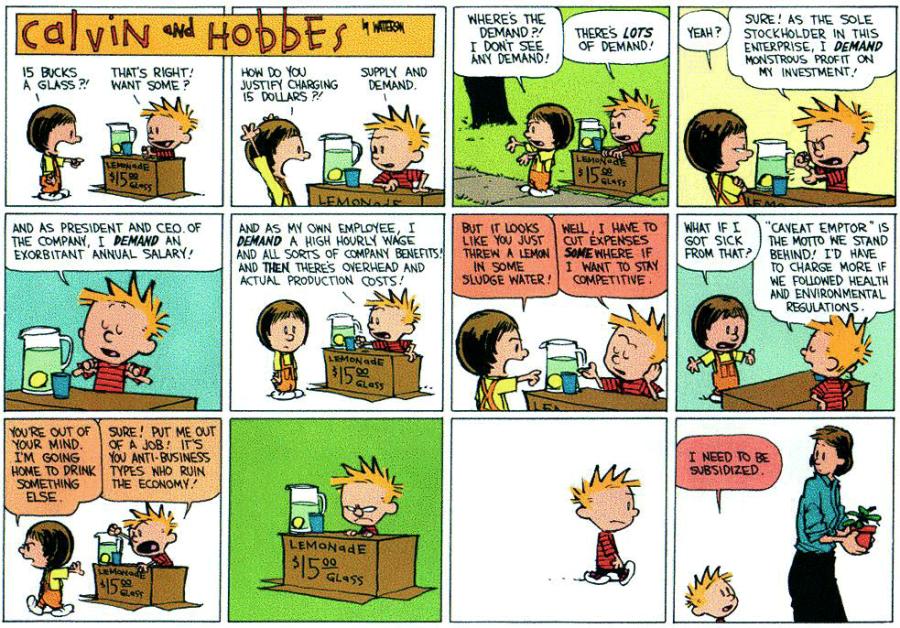
  • (HT: Josh) A great Calvin & Hobbes that is apropos for the current economic mess.
  • MiI and Hirhurim discuss R' Ovadia Yosef's psak that women can read megillah for men if no men are able to.
  • A cute article on using Faceboook to move up the social ladder. It's like having people vouch for you without them having to do so.
Enjoy!

Thursday, February 26, 2009

EZ Reads, 2/26/09

A little less out there today, but still some cute stuff and food for thought:
  • Wolf asks if there's any personal integrity left out there. Honestly, there is; but at the same time, I'm consistently dismayed by how often even some good friends of ours shrug off personal responsibility, communal responsibility, honesty, low-level theft, etc. It's really troubling.
  • The OU Job Board is offering free Quickbooks classes.
  • This piece on Freakonomics is difficult to sum up - just read it, it's fascinating.
  • EoZ has a few good ol' Jewish jokes that will bring a smile to your face.
  • Indexed notes how two people can see the same thing a bit differently. Cute.
  • Freakonomics asks people to say who the smartest person they know is. Feel free to submit your own.
  • A cute and interesting piece in the WSJ asking economists the best way to spend $8/week Obama's tax cuts will net.
  • Gil posts about the problem religious diversity creates for a man of faith, then addresses why he does not think it's a problem. The discussion is at some points rather interesting as well.
  • R' Aviner has an interesting explanation about why we pasken like Beis Hillel now, though we may follow Beis Shammai when Mashiach comes:
    We must understand that Beit Shammai discusses the world in the future in which our world will have a reality more appropriate to the stringent positions of Beit Shammai. Beit Hillel intended positions more compatible to our current world.
    I think that applied, this would be a good lesson to internalize in general regarding psak and our approach to chumros in specific. There needs to be an appropriate understanding of when we should be strict and when we need to live in this world.
Check it out.

Wednesday, February 25, 2009

EZ Reads, 2/25/09

The last 36 hours or so of reading were really good, reminding me what I enjoy about this whole blogging thing... so here are a few of the pieces I enjoyed:
  • Taking off on yesterday's post by Bad4 on how dating broadens your mind, Bas~Melech compares dating to blogging in figuring out which broadens your mind best.
  • YD laments a high school student's disgust over losing out lunchtime to a video about the Mercaz HaRav massacre.
  • A fantastic piece by R' Yonasan Goldson on BeyondBT noting how large scale division leads to an increase in localized homogeneous groups. It's quite a fascinating analysis with a very good message.
  • A beautiful and heart-warming post by NMF#7 about soldiers and babies.
  • A Soldier's Mother has another beautiful post on how the Israeli army rewards its' soldiers' hard work with a thank you... and how the soldiers thank God.
  • An interesting study concludes hand-motions help people learn math better. It mentions Italians, but I'd add Jews into that mix. On a separate note, I can't believe people get paid to research things I could show them in my living room.
  • Honestly Frum is incensed that after years of not only decrying the internet, but rejecting ads that included web addresses, Hamodia started a website and then justified it by noting it's a necessity of our time. I'm less troubled by the website (which I think is a positive sign of their joining the 21st century) and more troubled that the same logic which was rejected until now is suddenly accepted when convenient.
  • R' Gil Student at Hirhurim questions the idea of thanking the anti-religious for forcing religion to understand itself better, as per a recent WSJ piece.
  • SoccerDad notes that Shai Agassi is talking to 19 companies in Israel to help push electric cars in the country from a nice idea to reality. Awesome.
  • Freakonomics notes a site that lets you quantify Obama's SOTU address, like how he used "crisis" 11 times, while Hoover did 4 times during the Great Depression.
  • Though it's certainly not a perfect comparison, Basketball-Reference calculates that if Lebron were to play at the pace Oscar Robertson did in 1962 he'd be averaging 41/10/10. Sick. (Hat Tip: David Linn)
  • Win some Oh Nuts! stuff at ParshaBlog.
Enjoy!

Tuesday, February 24, 2009

Blind Melon

Holyman, I tell you man you gotta believe in what you see
Cause its you that corrupt us man and deep throat philosophy
I don't need your spells or the little games you try to pull on me
Come to think of it I don't need your religion
YD has a short but well-put post on chanoch l'na'ar al pi darko [educate each child according to his way] up at Adventures in Chinuch. A short excerpt:
Unfortunately, our school systems offer little variety in terms of Jewish education. The usual Gemara, Chumash, Navi, Halacha, Ivrit classes make up 99% of what our schools are teaching. Additionally, not enough is being done in the area of creativity to spark learning interest (although this is a good example of what a little hard work can do). This is not a simple subject to approach, due to the myriad of factors that are involved, but one that needs to be addressed. And if we don't, we are in danger of producing students who say, "Come to think of it, I don't need your religion."
I recall telling Jewish Atheist on more than one occasion after hearing some of his arguments and experiences that while we grew up similarly in many ways, had he simply had a better education he would undoubtedly be a happy, religious Jew today. While he might disagree with that assessment, or even more likely say that he "hopes not" because of what he thinks of Judaism and its teachings in the present, it is so often the case among the skeptical bloggers and others who have abandoned Judaism that they were presented with a one-size-fits-all education approach. Note that this is not a problem exclusive whatsoever to "Yeshivish" schools, but is sometimes just as true in Modern Orthodox institutions as well, as is clear from books, the skeptic blogs, and good old anecdotal information.

Once a person feels truly excluded from the Judaism they are being brought up in, they are as likely to abandon it quickly as they are to find another 'branch' that suits them better. While obviously having every school teach every viewpoint would be impractical and slightly ridiculous, it is important to balance whatever is being taught with an understanding that in many areas there are multiple viewpoints. The reason the one being taught is preferred within a hashkafa can be for various reasons - but that others do in fact disagree.

I've long felt that one of the best portions of my own education was a little, easily forgettable [somewhat] weekly program that WITS has for seniors called STAMP - Senior Torah And Mussar Perspectives. One objective of it was to present important subjects and somewhat controversial subjects within the Orthodox community in a framework that explained fairly both sides of these debates. The style was a short introduction explaining both sides by the Rebbe - including pros and cons, praises and criticisms - followed by a fully open question and answer session for 45 minutes, at which point it would end no matter what. By being able to learn about and discuss these subjects, we gained not only a greater understanding of them, but we were able to see why we were educated and taught a certain way and judge for ourselves whether that was appropriate for us and what would be appropriate for us and our families going forward.

I think there needs to be greater implementation of similar programs, though it is sadly difficult to find people who can fairly represent sides with which they do not agree. (I am still impressed that Rabbi Cheplowitz in WITS was able to do so so well at that time.) I also think such programs should not wait until one is a senior in high school, though certainly there are different levels of understanding and it should be suited to each age bracket. What we were presented with as seniors would certainly have been disastrous as freshmen.

Hopefully, at some point, such programs will no longer even be necessary.