Pages

Showing posts with label Facebook. Show all posts

Friday, July 01, 2011

Google+... +++

Ezzie: Tried posting this a couple nights ago, but didn't publish for some reason. Enjoy.

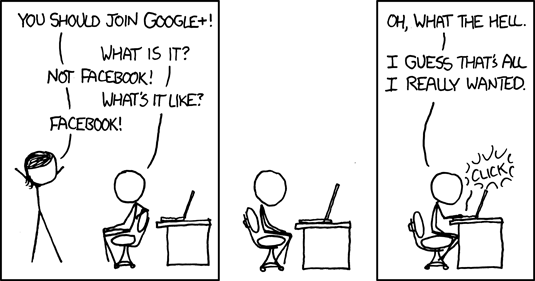
Jon nails why Google+ is off to a hot start, but to add to it - the accompanying xkcd is spot-on, plus there's the actual product: It's everything you want on Facebook, minus all the stuff you don't, with the ability to customize a bunch of stuff as you'd like to. The most important things to me are selective sharing, ability to restrict whether something I put up can be shared by others, and communication by group rather than all or nothing. So far it's pretty impressive.

On one hand, you'll never be able to convince your parents to switch. On the other hand, you'll never be able to convince your parents to switch!

Thursday, March 03, 2011

How the Internet is Saving the Speech... and Creating Honesty

Peggy Noonan has a really interesting article a few days ago which discusses an interesting twist in modern history. I will admit that after reading the article I started thinking about my own internet usage and realized that what she was saying seemed to be correct. For a number of reasons, the internet has suddenly become a place to share serious ideas* - to write long, explanatory essays, to post a reasonably lengthy speech, to actually share ideas in full rather than in soundbytes.

I would posit that there are many reasons for this, but a few primary ones that come to mind are the speed of the internet; the freedom of the internet versus broadcast media; the desire of people for more substance thanks to their access to more information; the overwhelming nature of available information forcing people to pull back a bit from the overload; and the advent of social media. For decades, broadcast media and advancements in technology allowed the news to add more and more information to their broadcasts... but the time slots didn't really change. Each piece of news was compressed more and more, and despite larger and larger chunks being moved to other places (running news and stock tickers, specialized channels, etc.), the media simply compressed everything down to short soundbites and videos. In turn, politicians and others began doing the same: Rather than risk a longer speech being taken out of context, they simply turned their speeches and rhetoric to similarly short and easy to digest soundbites to get their messages across.

I don't know that the early days of the internet were too different, either. The essay began a slight resurgence, but with the majority of people still used to receiving soundbites, information was still often relayed in soundbite form. Even today, news sites still often follow that very same template: Short bursts of news all over, linking to news stories that are not particularly long. Without even scrolling, each one of those sites has about 15-20 articles for me to click through to, along with dozens of sections and subsections that I can get to with a click or two.

But outside of news media, it seems, times have begun to change. Perhaps it was TED posting 18-minute videos... and people finding out that people actually watch this stuff... and not only that, they really like it. Perhaps it was the sudden burst in upload and download speeds, allowing people to actually post a 15-20 minute speech in just a minute instead of an hour. Perhaps it was Hulu and the networks allowing people to get used to sitting down and watching something for a while on their computer. Perhaps it was the overload from thousands of blogs and news sites and links that caused people to start trying to focus their attention on only things that truly interest them. But whatever "it" was, people suddenly are far more willing to sit down and pay attention to something that's worth watching, to sit and read through an article or blog post or essay that makes some salient points. On top of that, the more people would see links posted by friends on their GChat statii or on their Facebook walls or even linked by the anti-substance Twitter, and then even more so when people would start showing their "Like" of something, the more willing they were to check it out themselves. Instead of being a random link, it was now something which was recommended by any number of friends, and therefore something you would be more willing to stick out to the end.

Most likely, this renaissance was a combination of most of the above factors, but it has led to a beautiful change in how we live and think. Ideas of substance are now able to get past the noise, past the soundbites, and demonstrate themselves in full. Yes, there are still some catches: Much like in entrepreneurship, there's still the need for an "elevator pitch" - a short summary that shows something will be worth watching or reading. In entrepreneurship, the elevator pitch merely gets a person to listen to the substantive idea which will allow them to determine whether they wish to support an endeavor. Online, the same is now becoming true: Rather than the news model where people are given soundbites and then asked to make a choice, people are being invited to listen to full, fleshed out ideas and make decisions from there. Suddenly, people are interested in more than soundbites.

Noonan gives a great example of this from a recent election:
Look what happened a year ago to a Wisconsin businessman named Ron Johnson. He was thinking of running for the Senate against an incumbent, Democratic heavy-hitter Russ Feingold. He started making speeches talking about his conception of freedom. They were serious, sober and not sound-bitey at all. A conservative radio host named Charlie Sykes got hold of a speech Mr. Johnson gave at a Lincoln Day dinner in Oshkosh. He liked it and read it aloud on his show for 20 minutes. A speech! The audience listened and loved it. A man called in and said, "Yes, yes, yes!" Another said, "I have to agree with everything that guy said." Mr. Johnson decided to run because of that reaction, and in November he won. This week he said, "The reason I'm a U.S. senator is because Charlie Sykes did that." But the reason Mr. Sykes did it is that Mr. Johnson made a serious speech.
I've noticed as I've had more time to read blogs and the like that I've grown even more tired than ever of the "news" sites and their short links to matters with so little substance. I'm far more interested in the great essayists (the Treppenwitz and A Soldier's Mother types) and the people who discuss interesting subjects or their own lives. I love the discussions on these blogs, the back and forth between (mostly) good, reasonable people with great points on every side of an issue (even you, JA ;) ). I also enjoy people like RafiG and JoshWaxman who not only have their own substantial posts, but also link to good pieces on other blogs (similar to this blog's EZ Reads). And of course, I enjoy reading the writings of my friends and relatives. And the Muqata.

It's a beautiful change, and hopefully it will lead to more substantive action in the real world as well. Political discussions can no longer hide behind ten-second quotable quotes, but must now expand to include facts and reasoned opinions based on those facts. Government, companies, and people can no longer hide behind vague statements, delays, or excuses, but must reply with honesty and forthrightness. One of the best traits of the internet is its ability to bring information to the light of day, and one of the worst traits of those who care for themselves above all others is that they thrive on the suppression of information or the promotion of falsehoods. As people are more and more willing to focus on substance over all else, it becomes increasingly difficult for people who do wrong to hide behind soundbites and pointed fingers, lies and character assassination - they must now answer with facts, reason, and transparency.

We are all better off for it.

* Don't worry, G, the humor isn't dead by any means. It just has to be longer. :)
Friday, February 18, 2011

EZ Reads 2/18/11

Today's links are mostly fun as opposed to serious, so have a good time and a great Shabbos!
  • R' Gil caps the symposium he's held on his blog about the ethics of brain death and organ donation with Part X and gives a closing statement. Excerpt:
    This symposium was not a dialogue. Such a conversation is extremely desirable. Until that happens, the warnings offered by many participants to proceed with respect and caution are worth heeding. ... Until we are able to listen to each other, we will never be able to talk. We did not solve this dilemma here but we can at least leave knowing where the problem lies.
  • R' Moshe Grylak in Mishpacha (hat tip: Chana):
    We met in a certain shul. And this is what he reported: “What can I tell you? I’m a kollel man, I learn well; I even enjoy my learning, and I stick to a regular schedule. But I’ll be honest with you — I don’t believe in G‑d. Everything I do is just a sham.”
  • Chana writes a difficult piece on Why We Cut.
  • Via Diana, there are some nice pictures as CrownHeights.info highlights Cleveland's Friendship Circle which held a dinner for 120+ people for the volunteer-based organization, which works with children with special needs.
  • Via Ariella, Divrei Chaim rants about ads promoting luxurious trips... to kevarim.
  • Really cool: Wires transform objects from inanimate to hilarious pieces of art.
  • Doghouse (cartoon) explains how to explain things to teens these days.
  • Why patience matters when selling something online (Lifehacker).
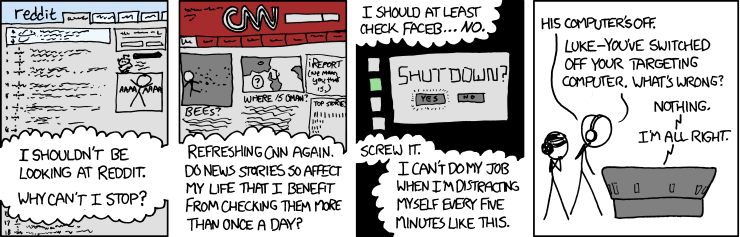
  • And finally, xkcd does it again in Let Go (wish I could do what he does in the scroll over text):

Monday, February 14, 2011

Hemorrhaging Orthodoxy

About a month ago, R' Gil at Hirhurim put up an interesting post entitled Orthodoxy in the Future, in which he concludes by asking:
Is Orthodoxy about to hemorrhage Jews?

After the session, I spoke with R. Steven Pruzansky and he thought I’m overly pessimistic. He remembers an Orthodoxy with a defection rate of 30%. Today, he estimates, it must be 15% or lower. While Orthodoxy will lose members, perhaps at a higher rate than in recent history, it will continue to grow at a quick pace and become a much larger proportion of the Jewish community.

What do the thoughtful commenters here think? Is Orthodoxy going to continue growing as a proportion of the community or begin shrinking?
The comments section there is rife with interesting discussion, including the recollection that in 1965, Orthodoxy was predicted to be on its way to death in the United States - only to end up far stronger as the decades passed. More recently, some may recall the signs that used to be posted all over predicting a huge wave of Orthodoxy as the higher birth rates and lower defection rates as compared to Reform and Conservative Judaism would allow Orthodoxy to become the strong wing in the Jewish community; yet at 5-6%, that seems to not quite be the case at this point.

I'm curious as to whether people think Orthodoxy will face a wave of attrition over the coming generation, and I wonder if technology - particularly social media - will add to that wave. Though more small scale, one feature I've noticed among people, particularly singles, is that if they are not very tied to the community in which they are living (and sometimes even if they are), they often drift away. This is not necessarily because they're no longer tied to a community with norms to which people can conform, but a bit more because of deindividuation, or "doing together what you would not do alone." People who might otherwise not cross certain lines are more likely to do so when they know others who cross those lines, and the advance of technologies such as social media make it much easier for people to see what others are doing and to slowly shift in those areas. (The Huffington Post has a piece that discusses young people and religion in a different vein -that technology makes the earth 'flatter', leading to less "brand loyalty"; hat tip XGH.)

I think that this could become especially prevalent as the Orthodox world struggles mightily with the economic structure it has created; teens and young adults who see their parents frustrated, if not distraught, over heavy tuition payments on top of high costs of living in Orthodox areas will be impacted the most. Some may be strengthened by the sacrifice, while others will wonder if it's worth it when other Orthodox (or "Orthodox") friends seem to be far less stressed by taking religion a bit lighter. Throw in an educational system in which teachers often are not fully prepared for students with access to questions and data with which they are unfamiliar, and are unprepared if not unqualified to discuss, and there's a recipe for serious disaster.

There certainly is another side of this: Orthodox Judaism's overall stability will be welcome in a constantly shifting world, and (to me, at least) its discussions have far more satisfying answers than can be found in most places. Some will be inspired by the sacrifices their families have made; communities are (finally) waking up to the economic realities and some are working to address those wisely; and there are numerous good, young (and old) teachers in the market who have 21st-century savvy, who are able to properly research and discuss difficult subjects with their students. Access to one another and each others' lives allows us to see everything, not merely the "fun", and to share inspiration, meaning, and encouragement far more easily than was ever possible in the past. Orthodoxy certainly is not without the ability to understand its positive alternatives, and do its best to make those into reality.

While it is impossible to know in what direction Orthodoxy is headed in the coming decades, it seems as if the transition will be incredibly fascinating to be a part of.

Tuesday, March 31, 2009

The Facebook Haggadah

Since I've already been sent this a bunch of times... here. "The Facebook Haggadah". Admittedly, it's funny all the way through. Here's the beginning:
The Passover Seder, the oldest continuously observed religious ceremony in the world, tells the story of the Jews' Exodus from Egypt. Jewish tradition says that people of each generation must imagine that they personally had departed from Egypt, and the sages say that each generation must tell the story in its own terms.

The sages probably did not intend this.


Moses is Departing Egypt: A Facebook Haggadah


Joseph is going to Egypt.

Joseph and Pharaoh are now friends.

Elijah is a bit tipsy, but off to a good start. 30,000 households down, and its only 6:30!

Pharaoh is sad to report that my father has entered immortality. I have taken his place in government and will do my best to honor his name.
Joseph Congratulations to you, my master.
Pharaoh Who are you, and why are you writing on my wall?
Joseph I meant no disrepsect, my master.
Advisor He is an Israelite. There are many of them. I do not know whether they are with us or against us.
Pharaoh Let us deal shrewdly with them, lest they join with our enemies in time of war.

Rabbi Eleazar ben Azaryah finally figured out why we're supposed to tell the story of the exodus at night. It's because it says "all the days of your life!"
Ben Zoma Huh?

Monday, March 02, 2009

EZ Reads, 3/2/09

Following are links to two of the best posts I've read in a while.

YD writes a beautiful piece utilizing a point from Parshas Terumah, explaining how logic does not necessarily progress to eternity:
The first step is for a person to be honest with himself or herself.

This, I believe, is a large part of the flipping-out phenomenon. Kids are being inspired to take their religion more seriously (which is a great thing), but are not given the tools to make decisions within gray areas. Therefore, many of them shift to the extreme because that's the only thing they can logically formulate. They need to be taught to take the emotional aspect, the lev, into account as well, both in terms of mental health and persistence
In a discussion I found rather related, Moshe related a story from his entrance interview to medical school, where a (Jewish) professor challenged his religious views, bashing them. He then expounds on how he thinks and acts:
The difficulty and frustration this presents is that I often demand this same process from those who are closest to me, my friends and family. I expect them to think before they act, to understand what they are doing, to appreciate their practices, and to recognize that actions without thought are pointless. I find myself frustrated and upset when people (especially family and friends) act without reason. If someone has thought about a topic and comes to a different conclusion, that is fine. However, it hurts me when they act without thinking or say and do certain things without understanding “the why.”
Elsewhere:
  • The Wall Street Journal and Wolf (twice) discuss The Event, last night's concert at Madison Square Garden starring Lipa Shmeltzer - which was canceled last year due to hubbub and meddling by kannoim. LoR links to pictures and video from the concert.
  • On a somewhat related note, ADDeRabbi with a line on the role of a Rav. Perfectly put.
  • A rather brilliant analysis of defense and how the Rockets shut down Lebron last week. (Also shows just how good he is in general.)
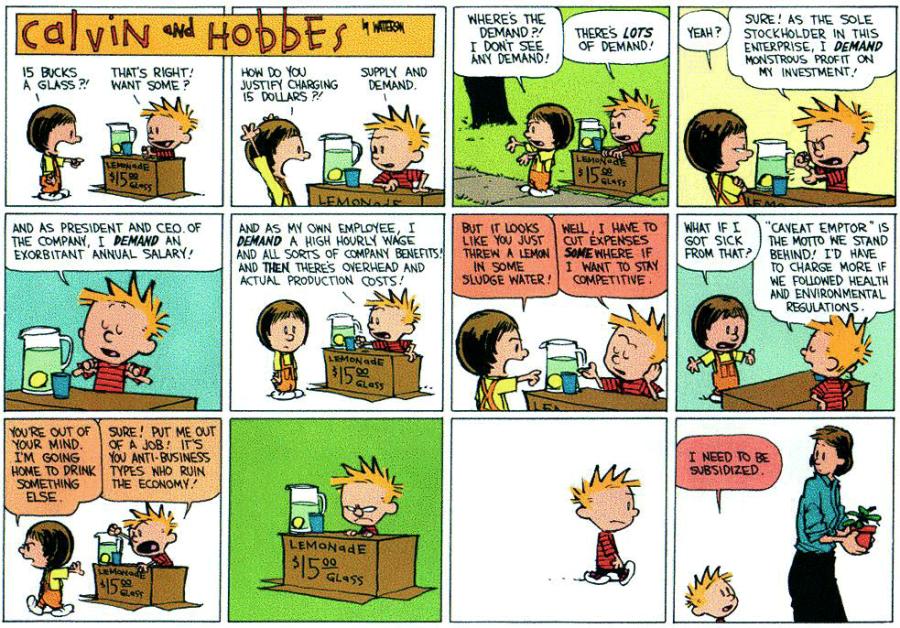
  • (HT: Josh) A great Calvin & Hobbes that is apropos for the current economic mess.
  • MiI and Hirhurim discuss R' Ovadia Yosef's psak that women can read megillah for men if no men are able to.
  • A cute article on using Faceboook to move up the social ladder. It's like having people vouch for you without them having to do so.
Enjoy!

Monday, May 05, 2008

What I Think Of Facebook

...which is why I'm more than a little wary of it. I have it, just can't say I use it much. Therefore, this is absolutely hilarious. (Hat tip: SaraK)
With over 69 million users (says Wiki), it's safe to say that Facebook has become the site to use when it comes to social networking. But if you stop to think about it, what is the purpose of a "poke"? Would you go up to an old friend you haven't spoken to in years and jab him in the shoulder with your finger? This rendition of what Facebook would be like in reality did make us take a minute to think about the absurdity of the whole thing — but nothing will ever keep us from loving every time-wasting minute of it!

Monday, January 07, 2008

Let's Cheer Up Ezzie

For all your Stoggers and Blalkers and Blurkers and Lurkers and even just regular Bloggers, you might have noticed three things in this post.

1. Ezzie had a bad day
2. Ezzie likes pickles
3. Ezzie had a lapse of sanity and gave me blogging rights.


Well to cheer him up how about we all chip in and get him one of the newest facebook gifts available.