Pages

Monday, March 09, 2009

Five Years (How I Met Serach, Part XIII)

This is Part XIII of a series about how I proposed to Serach. To see the series, you could simply use the dropdown menu on the right side of the blog or this link right here titled "How I Met Serach".
It's hard to believe it's been five years [see below]. Happy engagiversary, Serach!! Let's celebrate by fasting all day! :) ...It's also hard to believe that I actually started this series three years ago and still haven't finished. {wince} When I started this series, I didn't realize it would be a series. I thought I'd tell quickly the story of our engagement, which was a lot of fun, but as I started to do so, I realized it didn't make sense without the background. Once I started writing, we thought it would be amazing for us to have written down as much of what we remembered from our time spent dating as we could and keep it for posterity. At the same time, we also liked sharing what we felt we learned while dating, what we found to be important and what we found to be unimportant. In the process, however, we dragged down the story, so in the future, we're going to try and get back to telling the story, and then discuss different things afterward. In this segment, however, I'm putting the story on pause again, this time right before we discuss our first major hurdle, because we were discussing a lot of things recently that fit in well at this point in the story.
Five years. Truth be told, it didn't really hit me just how long ago that was until recently, when we were at the Lander Alumni Shabbaton. I was talking to a few friends, and somehow the subject came up; when I said that it was about to be five years since those times, it was a bit of a shock to them, but more surprisingly, myself. It's hard to believe that everything that we can so clearly remember is from so long ago. These are people who knew me before I knew Serach, who roomed with me while we dated and got engaged, who saw the development of that relationship from the beginning. When Serach and I think back, we recall just how much went into those 3-1/2 months of dating, just how much emotion and time and energy and effort - and then there were another few months of engagement, with all the planning and stress and discussion and craziness and preparation for marriage itself... and that's all just on the input side in a short few months amidst other details of life.

At the time, we weren't much different than most college students. Serach was in the Lander College for Women in Manhattan, going for a Judaic Studies degree to move more quickly into a Master's Program for Education and Special Education. I was in my first year in Lander in Queens, going for an accounting degree; economics wasn't offered, and a finance/political science double major would have taken too long. I talked to people about how to best approach the accounting degree if I wanted to eventually go to law school and get a JD-CPA; I even borrowed a draft LSAT from a friend to try, and talked to my sister about law schools around different Jewish communities outside of New York. At the time, the University of Virginia's law school was ranked highly, and I remember trying to figure out whether it was a feasible choice if I lived in a place like Baltimore. (Er, it is not.) It is fascinating to think back to what we thought then, what we felt then, what our approaches to different aspects of life were then, and to think back and realize just how different and often naive those were.

A friend of ours was here for Shabbos recently, and we were talking about the interesting differences in perspective and understanding people gain as they mature - and yet constantly discount the comments and advice of those who are a stage or two ahead of them in life as people who "just don't understand" their situation. Everyone can remember when they were in 8th grade, looking down at the younger kids and thinking just how much they still had to learn. In 10th, anyone coming into high school was just a dumb freshie. At graduation, there was a sophistication that 10th and 11th graders simply could not appreciate. Anyone who's been in Israel knows just how much more developed their thoughts and hashkafos are than a high school kid; anyone in college knows just how confused and out-of-touch a seminary girl or yeshiva guy are with reality. A senior in college looks back at the naivete of a first-year; a post-grad can't imagine how they lived in that college bubble. And yet, at each stage, nobody is willing to truly pay attention to whatever anyone ahead of them is saying, though all in all, this is probably not a bad thing: Much of life must be experienced to be understood.

Perhaps this is my own current stage bias showing, but as we discussed this, we noted that around when a person moves into "real life", this constant upgrading changes dramatically. There's no larger difference in mentality than the one between someone who has finished college and someone in college after that point. Once a person takes that step forward into the rest of their life, there really is no looking back. Whatever path one chooses to start will shape their future in many ways, even if they eventually decide to try and switch whichever path they are on. A person who has been working for even a short period of time and a person who has been working for 30 years relate to each other more easily when discussing life's challenges than a college student would relate to either.

It is certainly true that we are all products of our life's experiences. When we were talking to our friend who was visiting for Shabbos, she noted that her own experiences (divorce after about a year of marriage) had changed her mindset and maturity in ways that people just a couple of years younger than her simply could not grasp. There is something about being forced to truly form your future that changes a person in a different way. For some, this comes when they finish college and start choosing that path in life; for some, it comes from a long and difficult life-changing experience. While we talked, I mentioned the excellent book Miracle Ride by Tzipi Caton, and [slight spoiler] how she discusses in the end how hard it was for her to relate to her old friends when she recovered. Though just 17, I believe, she chose to date and marry an incredibly and kindly man who - though many years her senior - could relate to her in ways others never really would be able to. His own divorce helped him to appreciate the complexities of life and how different experiences change a person, not somehow damage them. She writes about relationships earlier in the book, saying
"I felt that the relationship could be a lot stronger if based on what be both got and learned from our experiences rather than the experience itself. Two people don't have to go through the same rough ride in order to make them right for each other. What makes them suited to each other are the similar perspectives on what they have gone through individually."
People sometimes, if not often, forget this. When people look for a spouse with whom they have something "in common", there is a tendency to search for someone for that person who has had similar experiences. It is not the similar experiences that make it work, though - it is how the person comes out of their life's experiences, how it molds them for the future.

When Serach and I were first dating, and a few mutual friends eventually found out, there was a slight hesitancy on their part - as so often happens with friends, they simply "didn't see it". We were too different. Serach was the outgoing, fun, but a little high-strung one; I was the calm but shy and passive one. Serach was the unpredictable and exciting "livewire"; I was - well, I was going for accounting. A few years later, these are some of our closest friends, those who understand us as a couple best. I remember having a conversation a while back with another close friend who'd gotten married a few months prior about marriage in general and the bond it creates that people often do not quite appreciate. People underrate the strength a marriage has in general, and that only gains as the years go by, even when - if not especially when - things are difficult.

Certainly, the last five years have included plenty of stresses for Serach and me. But those pale in comparison to the good and positives that have come out of our marriage, from our own relationship to our joined path in life to (of course) Elianna and Kayla. As my sister-in-law noted when we got engaged, we were headed to a "lifetime of free entertainment", and that has certainly been the case. The past five years have been a miracle ride of our own, and it has only prepared us that much better for our future together. Happy anniversary, Serach! :) [click on the pic to enlarge]

Touro Buys New York Medical School

This is a pretty impressive move:
All those who attended the Lander College Alumni Shabbaton were privileged on Saturday night of the Shabbaton to hear a brief speech from Dr. Bernard Lander, the founder of Touro College, and the namesake of its branch in Queens, the Lander College for Men. During his speech, Dr. Lander shared with the crowd the very exciting (but yet to be finalized) news that Touro College has [...] decided to purchase the New York Medical College.

Sunday, March 08, 2009

Getting Ready

...for this year's fantasy baseball draft. Our draft is next Sunday, and I don't even know what teams people have moved to outside of the Indians, let alone who's closing for more than a few teams. Last year, I followed a pitcher-heavy theory which was moderately successful, coming in second place, but well behind the first-place finisher in a league of 14 teams. This year we're down to 13 teams [unless a 14th person is suddenly interested - anyone?], and I have the #3 pick in a typical 5x5 league. One twist we've added (OBP instead of AVG didn't get enough votes) is to allow people to "draft" unlisted prospects by taking an inactive P or something like it and announcing who it is representing. If/when the rookie makes it, the team can then drop the no-name for the rookie.

So: Who are your top three players that you must take whichever is there at #3: Hanley Ramirez, Chase Utley, and Albert Pujols? (How they stack up against their positional counterparts is important.) And what prospects would you consider, whether in the majors already or not? Who are your "steals"?

It's an 'odd' year, so that means all my Indians are worth picking, right? :)

Saturday, March 07, 2009

R' Feitman on Yoatzot Halacha: Second Letter

In this past week's Five Towns Jewish Times, there was a piece published by R' Yaakov Feitman (formerly the Rav of my parents' shul in Cleveland, currently the Rav of "The Red Shul" in the Five Towns) about the issue of Yoatzot Halachah - female halachic advisors. Upon reading the article, I will readily state that I was less than impressed by the arguments cited. Certainly, the examples of a shtender or the tzuras haDaf as examples of not altering our mesorah came off poorly; as commenters on the piece noted, it is difficult to imagine that Moshe Rabbeinu learned at a shtender or that a form created by a non-Jew to allow for easier printing is somehow such an important part of our tradition. Furthermore, only after a later closer reading was it clearer just how R' Feitman intended the role of the rebbetzin and how that was quite dissimilar to that of the proposed yoetzet. Prior to that, my reaction had been to wonder how what he described was different than what was expected of a yoetzet.

Between my own confusion as to his article and after reading other (disrespectful) criticisms elsewhere, I decided to contact R' Feitman asking for a clarification: [e-mail was sent to Rebbetzin Feitman; only relevant parts included]
I'm writing because I feel like your husband is going to get harshly criticized for the Yoetzet piece in the 5TJT. [...] the substance of the piece comes off rather weakly, I have to say. A careful reading suggests that a few points come off a little differently than he may have intended, so perhaps a clarification would help, though certain points simply don't work well.

Not sure why I'm writing this, just felt somewhat frustrated reading it originally. Perhaps R' Feitman could rewrite it in a way that comes off more clearly? I don't know. But it felt important enough to comment to you/him about.
R' Feitman wrote a letter in response to me, beginning with a simple statement noting that he has no further intention in responding in any way, feeling that he has said what he needs to say and is moving on to other things. He then shared a few thoughts for my own sake, but allowed me to quote him if I felt it would be productive. As I had a much greater understanding of his position after reading the points he made, I have decided that the same may be true for others and have decided to do so. [again, only relevant portions included]
Dear Ezzie:

Sholom Aleichem.

[...]

Regarding your e-mail and my article, [...] I actually have no intention of further responding in any way. I said what I needed to say and am moving on to other things.

However, for your sake only, I will share a few thoughts. Feel free to quote me if you feel it will be productive:

1. I purposely did not cite sources.

Much of Torah decision-making and Hashkafah positions are more related to the essence of the Torah and elemental issues than to a particular footnote. It is famous that Poskim treated the "Yirah Li" ("I believe") of the Rosh as a stronger statement than when he sourced his P'sak. There is a famous story to this effect as well with Rav Chaim Soloveitchik and Rav Chaim Ozer Grodjenski. As a matter of fact, Rav Soloveitchik ZTL used this method in responding to Ben Gurion's famous "Who is a Jew?" query. He chose to answer succinctly and with almost no sources jointly with Rav Chaim Heller. The point he was making was
  • a. There is no need for us both to respond since this is basic and there is only one Torah;
  • b. This does not require lengthy analysis or pilpul. It is self-evident-poshut.
2. The points about women being more comfortable with a woman than with a man are of course all valid. My only contention was that this has certainly not gotten worse in recent times. If anything, I believe the opposite is true and there IS a time-honored approach to this matter. I am well aware that Nishmat advocates that the Yoatzot turn to a Posek for complicated or novel issues. However, this is not enough. The sense from the Nishmat web site and literature is that they believe their training is sufficient for the overwhelming majority of Shaalos. This is simply not true. They provide a great deal of INFORMATION. However, even basic P'sak often involves methodology and training far beyond the purvey of those with a thousand or even two thousand hours of study. It is, of course, true that not every Rov is a Posek or the expert we all ought to be. But that does not justify ejecting millenia of tradition.

3. I never, obviously, would claim that a shtender, Tzuras Hadaf or particular type of shiur was the sine qua non of Torah study but the point I was making was that Tzurah or form is part of the tradition of Torah. Clearly, there are numerous legitimate forms -- Chassidim, Sepahardim, Hungarians, Litvaks each maintain authentic but different Tzuros. However, each of those groups would be guilty of a lapse in their own Mesorah if one of their leaders unilaterally cancelled his own tradition even in favor of one of the others. Rav Hershel Schechter, who speaks often in my Shul, has written eloquently in his Nefesh Harav (in the name of the Rov) and especially in his lengthy essay "Tz'ei Lach B'ikvei Hatzon" of the requirement in Torah of emulating earlier generations in both format and substance. This applies most urgently to this subject because we are speaking about the Mesoras Hatorah. We have nothing more sacred than this.

4. Another source which I did not quote (but of course could have) is the famous Yam Shel Shlomo No.9 on the Gemara in Bava Kamma 38a which seems to indicate Jewish bias toward gentiles concerning monetary matters. The Maharshal in this sefer asks, why couldn’t the rabbis have simply withheld the one Mishnah in all of Shas which caused difficulty? The answer, he writes, is that when it comes to presenting the Torah accurately even a sin of omission is as bad as a sin of commission, and may not be utilized even if it means putting all of k'lal yisroel into danger. Analogies are always imperfect and dangerous but it is clear from this Gemara and Maharshal that one must be extraordinarily careful when tampering with any Mesorah.

Those who make the point about changes brought about by individuals such as Sarah Schnierer etc. are correct. However, she did go to the Chofetz Chaim, Gerrer Rebbe and others, the Gedolei and Ziknei HaDor, who with the the most profound of gravity, decided that these innovations were acceptable and necessary for the survival of K’lal Yisroel. This process has certainly not happened with the Yoatzot.

There is much more but it is Erev Shabbos [...]

B'ahava,

Rabbi Yaakov Feitman
At this point it is important to remember what R' Feitman's original intent was in publishing the article in the 5TJT:
...Since this was reported without critical comment or dissent, I feel that an alternative view must be presented to your readers. So please consider this article a macha’ah—one man’s protest and disagreement with the “rave reviews” this project has reportedly received.
His intent was not and does not seem to be to pasken or say with finality that the idea of a yoetzet is anathema to and must be rejected as an attack on Jewish tradition. Rather, he seems to be simply noting an alternative way of looking at the issue by making a few succint points about how it seems to have come about and what the purpose of it is, by questioning why it is necessary and what it really adds. This does not mean that there is no merit to the other side of the discussion, but merely questions whether those merits outweigh or countermand the tradition that is already in place and properly address the other points that have been raised. Certainly, it is worthwhile to think about these issues from both sides before rushing to judgment either way.

Friday, March 06, 2009

A Fraylichen Shabbos

<3 Diana, My Love and Barfla!

Mana Mana Purim Stimulus

Reb Abe sent this in, and it's really great. For those not in South Florida, just use the Mana Mana part! :)

EZ Reads, 3/6/09: Frumkeit

  • Josh at Parshablog discusses the implications of "miracle stories". Really good analysis.
  • Adventures in Chinuch with another excellent vort, this time discussing from the Parsha how Aharon teaches us a lesson in how we view ourselves and others, and attaches that to Purim and happiness.
    Aharon wasn't jealous of Moshe becasue he truly appreciated the differences between people. He truly understood that makes one person great does not impinge on the uniqueness of someone else. Every person has different talents and different faults. Therefore, everyone is destined for something else. When Aharon found out he wasn't going to be the leader, he wasn't jealous becasue he understood that this wasn't his purpose; this wasn't him. Therefore, he could be completely happy for Moshe. His simcha stemmed from his personal sense of purpose that nobody else could ever touch.
  • The Apple asks why frum people that otherwise know better seem to throw out certain parts of halacha at certain points in their life, particularly when it comes to tznius.
  • Ariella discusses a conversation with a mattress store owner where he relates that some will have covert deliveries of larger mattresses in neighborhoods where the standard is to have smaller ones. In addition, a charedi newspaper wouldn't print an ad that showed two pillows on one bed, citing implied inappropriateness.
  • An interesting essay on Orthoprax Jews by Yossi Ginzberg at HaEmtza.
Enjoy!

Thursday, March 05, 2009

Best Lines: Erashay Thursday

Erachet's best from today:
  • I'm really bad at crossing the street. [Erachet is 22.]
  • If you don't fall into the right crowd or don't fall into any crowd when you first get to YU/Stern, the weird guys, they find you, because they :::know:::.

Everything is Amazing, Nobody is Happy

Via A Negative Benefit, this is comedian Louis C.K. on the Conan O'Brien show making a very good set of points about life, appreciation, technology, economics, and people - really funny:

More Divisive Comments?

Anyone listening or reading the news knows there is a lot of stupid attention being paid to Rush Limbaughs comments about wanting Obama's policies to fail. His comments have been called divisive when have to be united. Flip it the other way around, and those on the left were well able to want Bush's policies to fail, but whatever. What I DON'T understand, is how come comments like this from a CNN host (just like Rush is a host) haven't been called divisive or wrong. Where is all the foot stomping outrage?


EZ Reads, 3/5/09: Rebbetzin Owns Ponoveitch

Wednesday, March 04, 2009

Life Is Yours

I've been doing this for a few years now (woah), and very rarely is there a post written that resonates so strongly with me. Perhaps it's because it's a close friend of ours who wrote it, and I appreciate it because of that; perhaps it's just because it really is that good. Either way, as I read this post, I couldn't help but pump my fist and think "EXACTLY!!" a number of times throughout.

So, ya know, read it.

Best Prank Ever

Imagine having 18,000 people in on a prank against just ONE person. Via Deadspin, this is one of the funniest things I've ever watched. And the earlier proposal prank was almost as good (watch it first, and you'll appreciate this one that much more).
Remember the Yankee Stadium proposal prank where one goofball used a fake marriage proposal to humiliate his goofball friend? Well, 18 months later, revenge is a dish best served at a Maryland basketball game.

The goofballs in question are Amir and Streeter from College Humor. While Streeter was on the "slapped in the face" end of the Stadium prank, he one upped his colleague this time by incorporating the entire crowd at last night's Maryland-Wake Forest game into his payback scheme. The set up: Amir believed he would be taking a half court shot for $500,000. The twist: He would be blindfolded, so only the crowd reaction would let him know if he had made it. The reveal....

With Talents on Loan from God

"We love people. [Applause] When we look out over the United States of America, when we are anywhere, when we see a group of people, such as this or anywhere, we see Americans. We see human beings. We don't see groups. We don't see victims. We don't see people we want to exploit. What we see -- what we see is potential. We do not look out across the country and see the average American, the person that makes this country work. We do not see that person with contempt. We don't think that person doesn't have what it takes. We believe that person can be the best he or she wants to be if certain things are just removed from their path like onerous taxes, regulations and too much government. [Applause]

We want every American to be the best he or she chooses to be. We recognize that we are all individuals. We love and revere our founding documents, the Constitution and the Declaration of Independence. [Applause] We believe that the preamble to the Constitution contains an inarguable truth that we are all endowed by our creator with certain inalienable rights, among them life. [Applause] Liberty, Freedom. [Applause] And the pursuit of happiness. [Applause] [...]

We don't want to tell anybody how to live. That's up to you. If you want to make the best of yourself, feel free. If you want to ruin your life, we'll try to stop it, but it's a waste. We look over the country as it is today, we see so much waste, human potential that's been destroyed by 50 years of a welfare state. By a failed war on poverty. [Applause]

We love the people of this country. And we want this to be the greatest country it can be, but we do understand, as people created and endowed by our creator, we're all individuals. We resist the effort to group us. We resist the effort to make us feel that we're all the same, that we're no different than anybody else. We're all different. There are no two things or people in this world who are created in a way that they end up with equal outcomes. That's up to them. They are created equal, given the chance - -[Applause]

[...] We want the country to succeed, and for the country to succeed, its people -- its individuals -- must succeed. Everyone among us must be pursuing his ambition or her desire, whatever, with excellence. Trying to be the best they can be. Not told, as they are told by the Democrat Party: You really can't do that, you don't have what it takes, besides you're a minority or you're a woman and there are too many people that want to discriminate against you. You can't get anywhere. You need to depend on us.

Well. Take a look [...] at all the constituency groups that for 50 years have been depending on the Democrat Party to improve their lives. And you tell me if you find any. They're still complaining, still griping about the same problems. Their problems don't get fixed by government. And those lives have been poisoned. Those lives have been cut short by false promises, from government representatives who said don't worry about it, we'll take care of you. Just vote for us. [Applause]"

~ excerpted from the keynote CPAC speech by Rush Limbaugh [emphasis added]
Growing up, I quickly learned to hate one person: Rush Limbaugh. My father used to work out of our house, and that meant that he would walk around with an annoying little hand-held radio, listening to Rush. I hated it. I would tell my father that this guy is pompous (his intro states the title of this post), he's loud, and his 3-hour show could be shortened to two if he'd talk a little faster. 15 years or so later, I still think all of those are true, and never listen to his radio show (if I listen to anyone, it's typically Michael Medved) - but he is also absolutely brilliant, speaking with a level of clarity most of us could only dream of.

The speech he gave recently to the Conservative Political Action Committee lays out beautifully just what conservatives believe, don't believe, and why - something which unfortunately has not been done in a long time. I had the radio on for a few minutes while I was driving yesterday, and Michael Medved noted that one of President Bush's greatest failings was his inability to communicate just what it was conservatism was and why people believe in it.

After a hilarious joke about his own arrogance at 2:45, at about 4:50 in this first part Limbaugh starts to lay out just what conservatism is. One of the most interesting things about this speech (and what adds to its impressiveness), mentioned at one point by Limbaugh himself, is that Limbaugh uses no teleprompters, and almost no notes (he seems to have a single piece of paper in front of him). He is simply stating his beliefs, and does so better than many politicians do with every word set out in front of them. I highly recommend watching this speech (whatever your political beliefs are or are not), and I'm posting the first two parts below. Enjoy!


Tuesday, March 03, 2009

Only So He Can Come to Cleveland

It's link to Jack day. :)

He's the man who helps put together Havail Havalim every week, helped round up posts during the war, and is just entertaining and interesting to read in general. He also posts at a ridiculous clip. So go check him out!

Snow Day

Monday, March 02, 2009

We're All In This Together

I thought some people might appreciate this:


I don't mean to take away from the posts below - go read all the stuff that Ezzie rounded-up! But hey, every other student or school-related person (like teachers) are off having fun today except for those of us at Stern (just to give you an idea of the likelihood that you will get a snow day if you go to Stern, according to a girl in my class, "I heard that in 1996 they once gave off"), but we're all in this together, right? I find this video fun! :D

EZ Reads, 3/2/09

Following are links to two of the best posts I've read in a while.

YD writes a beautiful piece utilizing a point from Parshas Terumah, explaining how logic does not necessarily progress to eternity:
The first step is for a person to be honest with himself or herself.

This, I believe, is a large part of the flipping-out phenomenon. Kids are being inspired to take their religion more seriously (which is a great thing), but are not given the tools to make decisions within gray areas. Therefore, many of them shift to the extreme because that's the only thing they can logically formulate. They need to be taught to take the emotional aspect, the lev, into account as well, both in terms of mental health and persistence
In a discussion I found rather related, Moshe related a story from his entrance interview to medical school, where a (Jewish) professor challenged his religious views, bashing them. He then expounds on how he thinks and acts:
The difficulty and frustration this presents is that I often demand this same process from those who are closest to me, my friends and family. I expect them to think before they act, to understand what they are doing, to appreciate their practices, and to recognize that actions without thought are pointless. I find myself frustrated and upset when people (especially family and friends) act without reason. If someone has thought about a topic and comes to a different conclusion, that is fine. However, it hurts me when they act without thinking or say and do certain things without understanding “the why.”
Elsewhere:
  • The Wall Street Journal and Wolf (twice) discuss The Event, last night's concert at Madison Square Garden starring Lipa Shmeltzer - which was canceled last year due to hubbub and meddling by kannoim. LoR links to pictures and video from the concert.
  • On a somewhat related note, ADDeRabbi with a line on the role of a Rav. Perfectly put.
  • A rather brilliant analysis of defense and how the Rockets shut down Lebron last week. (Also shows just how good he is in general.)
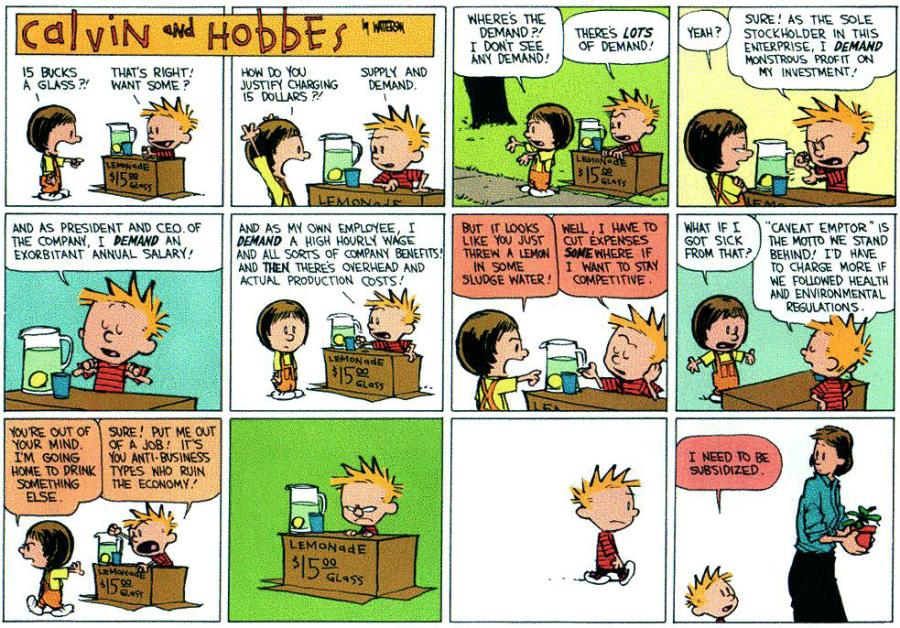
  • (HT: Josh) A great Calvin & Hobbes that is apropos for the current economic mess.
  • MiI and Hirhurim discuss R' Ovadia Yosef's psak that women can read megillah for men if no men are able to.
  • A cute article on using Faceboook to move up the social ladder. It's like having people vouch for you without them having to do so.
Enjoy!

10 & 19

We have two young ladies from Baltimore staying at our house at the moment. They were here for Shabbos and the engagement party for one of the girls' seminary friends, and were supposed to take a bus back to Baltimore yesterday evening. Due to the "winter storm" we were predicted to get, their bus got canceled - meaning they'd have to stay here at least through today.

But it was their reactions to the news that was so good. The two girls are sisters, one 19 years old, one 10 years old. The 19-year old immediately said "Oh no! I'm going to miss school! I have tons of work to do!" The 10-year old, of course, said, "YES! No school!!" Wouldn't it be nice to be 10 again sometimes?

Meanwhile, it looks like Cleveland outside. White, swirling, and cold. For all of those who have off today, enjoy! Go outside, build a snowman, have a snowball fight, and when you come back in, drink some good ol' hot cocoa.

Or you can pick a friend, walk to their house, walk in when they answer the door, and pelt them with snowballs. It is Adar, after all.

Sunday, March 01, 2009

JES Fact Sheet

A few interesting tidbits from the Jewish Economic Survey so far:
  • 45.3% of respondents rent their place of residence.
  • 56% of the people living within the NY-NJ area rent their place of residence.
  • 73% of the people living outside of NY-NJ (but within the United States) own their place of residence.
  • While just 6% do not have health insurance, over 40% of respondents do not have life insurance.
  • 74% of the respondents to the open-ended question “What do you think is/are the most important financial issue(s) facing the Orthodox Jewish Community?” included Tuition or something similar to tuition in their answer.
  • The average 1-bedroom apartment in the NY-NJ area goes for $1,111. The average rent married couples in the NY-NJ area pay for a 2-bedroom apartment is about $1,200 a month.
  • 2-bedroom apartments in Baltimore are rented at an average of $910/month. A 3-bedroom apartment increases the costs to $978/month.
  • The average mortgage for most married couples who own their residence in Baltimore is $1,469 a month – and they live in a 4-bedroom house.
  • In the Midwest (including people from MI, MO, OH, and WI; excluding Chicago, IL), the average respondent’s family lives in a 4-bedroom house and pays a mortgage of $1,187/month.
There's plenty of other data coming out of the survey, but the sample sizes are too small for most categories to feel comfortable enough to even mention them. Housing is an area which is easier to get a handle on more quickly, as a 2-bedroom apartment is a 2-bedroom apartment no matter how many people are stuffed into it. Life insurance you either have or you don't. But food costs are obviously greater even among otherwise similar families if one family has an additional child.

Of the statistics listed above, the biggest surprise is the cost of two-bedroom apartments in NY-NJ; apartments in Queens are far more expensive than that. On the other hand, people have who lived in apartments that size for 5 years or more would be paying much less than that amount, as prices started climbing fast right around the time we got married. In addition, apartments in Kew Gardens, Teaneck, and Passaic seem to be somewhat cheaper than Kew Gardens Hills or Washington Heights. In addition, while it was expected that a higher percentage of people in the NY-NJ would be renting as compared to everywhere else, the gap (44% ownership in NY-NJ vs. 73% elsewhere) is much larger than many people might have expected - and it's not as if the respondents are all young couples, either. 56% of the responses to date have been by people at least 30 years old, 21% from people 40 or more.

The lack of life insurance is a bit of a surprise. While one could argue that singles or even married couples with no children have less of a need for life insurance [and in fact, less than 5% of childless singles and 29% of childless couples have life insurance], the percentage of people with children who have no life insurance is over 23%.

If you haven't yet taken the survey, please do! The more people that take it, the better and more useful the data will be. And pass it along. :)