Often, when talking to friends about finances or cars or cellphone bills or something along those lines, friends will note that their parents cover their cellphone or auto insurance bills - whether they're simply remaining on their family's plan or whatever. While cellphones are less problematic, I've always thought that auto insurance could be - especially if the person moves out of state, it may even be illegal.
But even assuming that most people are doing it legally, it seemed widespread enough that on the question about how much auto insurance costs a person, one of the options is "Someone else covers my insurance." In total, 14.2% of respondents have their insurance covered by someone else, but obviously it's more important to focus on those in the younger crowd... and the numbers are really surprising. While I expected a sizable portion to answer that it's covered, I didn't expect 47% of the people between 18 and 24 years old who have cars to say that someone else covers the insurance. Even if we factor in singles vs. marrieds (and say that singles, especially if they're close to home, will likely stay on their parents' insurance), 39% of marrieds and 63% of singles have their insurance paid for.
Interestingly, all singles between 25-29 who have a car pay for their own insurance, while 81% of marrieds do - so the trend is not long-lasting. But for almost 2/5, then still almost 1/5 to have their insurance paid for while they're in their twenties is a pretty nice savings for the couple - while quite a drain on their parents' finances.
Thursday, April 30, 2009


Oh Stern Girls!
My sister sent me an IM with the following story.
Sister: Can i just tell you what happened in class today? The Professor asked "why does the Ramchal call olam haba a chupa?" and a girl goes "because isn't chupa the ultimate achievement"
Me: That girl is both stupid and wrong
Let's all take a moment to appreciate the stupid people. Would life be worth living if we couldn't make fun of them?
Serach's Grandmother, Edith Luchins
Via my mother-in-law, here is a beautiful piece about Serach's grandmother, Edith (Hirsch) Luchins, who was (among other things) a brilliant woman who was the first woman to serve on the board of the Orthodox Union (OU), the first woman to be appointed as a full professor at the prestigious engineering school, Rensselaer Polytechnic Institute (RPI), and had the privilege of being close friends with both the Lubavitcher Rebbe and Albert Einstein (the Rebbe used to send dollars to Einstein through her).
I never had the opportunity to meet her, as she passed away in 2002; Serach adored her.
The article:
I never had the opportunity to meet her, as she passed away in 2002; Serach adored her.
The article:
Edith Luchins is an inspiration for any woman. Her story is specifically interesting to me since she lived in New York City before she moved to the Albany area. She had an incredible life in pioneering in Mathematics and in the community.
Early Life and Education
Born Edith Hirsch in Brzeziny, Poland in 1921, she and her family emigrated to New York City in 1926. Edith was very good at mathematics. She was a member of the mathematics club and often tutored other students. One day, she decided to take a course in psychology which was taught by Abraham Luchins. Abraham was a graduate student in educational psychology at New York University. The course compelled Edith’s interest in cognitive psychology, as it applied in mathematics education.
A collaboration in the theory, and a romance, started between Luchins and Edith. She enrolled at Brooklyn College, receiving her BA degree in 1942. She and Abraham married after she had graduated.
During the war, Edith worked in support of America in the industry. Eventually, Abraham joined the army. During this time, Edith enrolled in a graduate program at New York University while teaching math at Brooklyn College. Edith received her M.S. degree in 1944 from N.Y.U.
Edith gave birth to her first child in 1946. She was not able to take her comprehensive exams or write her thesis upon completion of her courses. A second child was born in 1948.
In 1949, the Luchins moved to Montreal. They remained there for 5 years while Abraham began teaching at Mc Gill University. Edith worked with her husband in the area of psychological issues in mathematics. During this time, two more children were born.
In 1954, Abraham was offered a position at the University of Oregon. Edith continued her studies and received her PhD in mathematics in 1957. She gave birth to their fifth child year later.
Edith held the N.Y.S. fellowship of the American Association of University Women during 1957-58. At this time, she wrote several papers that were published in articles - On strictly semi-simple Banach algebras, and On radicals and continuity of homomorphisms into Banach algebras. Some titles!
Professor Luchins
In 1962, Edith started teaching mathematics at the Rensselaer Polytechnic Institute in upstate New York. She was the first woman to be appointed as a full professor at the prestigious engineering school. Her field was mathematics, of course.
Before her retirement from Rensselaer, Edith was also a guest professor of mathematics at West Point from 1991-92. Retirement wasn’t easy for her. She found herself back at Rensselear mathematics department. Edith was loved and adored by students and the faculty. She was appointed an adjunct professor of cognitive science in 1994. Edith received the Distinguished Teaching Award, the Darrin Counseling Award, the Martin Luther King Jr. Award, and the Rensselaer Alumni Association Outstanding Faculty Award.
On top of that, Edith was honored with the Award for Distinguished Public Service at West Point. In 1998, she was made an honorary member of the International Society for Gestalt Theory and its applications.
At one time, Edith directed a National Science Foundation study on why so few women studied mathematics. She collaborated with Mary Ann McLoughlin and wrote a paper on Olga Taussky Todd.
Edith received a grant from a Rensselaer Teaching Fellowship to integrate geometry and calculus through computer graphs. She has written 12 books and over 70 articles.
Edith died in 2002. Her obituary in the Renssellaer Campus News reads as follows:
Luchins’ research focused on mathematics and psychology. She had worked on mathematical models of order effects in information processing; on gender differences in cognitive processes and their implications for teaching and learning mathematics; and on the roles of heuristics and algorithms in mathematical problem solving, with and without the use of computers. She was also interested in the history of mathematics, and, in particular, the history of women in mathematics.
In the Albany area, she was very active member of the Congregation Beth Abraham Jacob where she established work in Jewish communal life. She was the first woman to serve on the Board of Directors of the Orthodox Union.
Edith Luchins was a great woman and role model for all women, and she concludes my series on women who overcame gender barriers and other obstacles to fulfill their dream. I hope you enjoyed learning about these people with me.
What is your dream? What are you doing to make it come true?
An Apt Comic
From Zero Hedge (the smartest blogger I've ever read... I think - I don't know how much I actually understand): 
No less an authority than FDR's Treasury secretary and close friend, Henry Morganthau, said in 1939: "We have tried spending money. We are spending more than we have ever spent before and it does not work…..I say after eight years of this Administration we have just as much unemployment as when we started, and an enormous debt to boot!" Similarly policy makers’ current aggressive actions remind me of the quote “Never in the history of the world has there been a situation so bad that the government can’t make it worse”.
And some comedy, compliments of the 1934 (now bankrupt) Chicago Tribune
Wednesday, April 29, 2009
Well Waddaya Know XXVI
Last week's Q & A:
Meir Kahana's group "Kach" had what symbol on their flag:This week's question is up to the right.
Votes so far: 67
Kach's flag was yellow and had on it a magen david and inside it a fist and the words "rak kach".
63
No, that's not a typo. My Dad's birthday is 5 Iyar, and he is now 63 years old - Yom Huledet Sameach, Dad! And on the English calendar, my best friend Shragi (of the Well Waddaya Know series) is 26 years old today, and I hope his hesder and Bar-Ilan friends remember that when they're all celebrating Yom Ha'atzma'ut today.
For Israel's 61st birthday this Yom Ha'atzma'ut, here a couple of the pieces I really liked from past years that were posted here. Shragi sent in a composition from someone titled "This Is Israel", and Stam wrote a beautiful piece last year called "Between Two Worlds".
For Israel's 61st birthday this Yom Ha'atzma'ut, here a couple of the pieces I really liked from past years that were posted here. Shragi sent in a composition from someone titled "This Is Israel", and Stam wrote a beautiful piece last year called "Between Two Worlds".
Tuesday, April 28, 2009
Choice Angst
My mother forwarded me one of the more interesting pieces I've read in a long time, and I think that a lot of the readership here will appreciate this one. It's titled So Many Choices in Life, So Much Angst, and it essentially argues, based on a study published in Scientific American, that people are better off just making choices rather than spending all their time debating them or trying to find "better" ones. A choice quote:
...when it comes to making decisions, people fall somewhere on the spectrum between two extremes: " 'maximizers' (those who always aim to make the best possible choice) and 'satisficers' (those who aim for 'good enough,' whether or not better selections might be out there)." In the end, the article said, maximizers are usually less content than satisficers with their final decisions -- they have regrets about what they might have had with one of the other options. The more options there are, the more opportunity cost there is and the more chance for regrets.We've discussed this before on this blog, but it's interesting to see it spelled out in a study like this. Read the whole piece, it's interesting.
Yom HaZikaron
I am not the person to write about this, really. Check out Baila (22,570*), A Soldier's Mother, and of course Jameel, who will have many other good reads.
* The number of soldiers and terror victims the State of Israel has lost since its creation.
Yehi zichrum baruch.
I've always appreciated the wisdom in the State's having Yom HaZikaron and Yom Ha'atzma'ut back to back, which allows for a nechama of sorts, as Treppenwitz put it:
* The number of soldiers and terror victims the State of Israel has lost since its creation.
Yehi zichrum baruch.
I've always appreciated the wisdom in the State's having Yom HaZikaron and Yom Ha'atzma'ut back to back, which allows for a nechama of sorts, as Treppenwitz put it:
In a couple of hours, the festivities will be beginning. Happy 61st birthday, Israel. May it put us on the path toward a full geula.Today is Yom Hazikaron (memorial day for Israel’s fallen soldiers) and tomorrow night begins Yom Ha’atzma'ut (Independence day).
The back-to-back proximity of these two days is intentional. It forces the mourners of the former (there are almost no families that have not lost a member or close friend) to recognize that their loss helped make the latter possible. Likewise, it forces the celebrants of the latter to understand the staggering price paid by the mourners of former.
Monday, April 27, 2009
Pazit: Empowering Jewish Women
Some of you may have noticed that one of the sponsors of next week's presentation on the Jewish Economics Survey is a new organization called Pazit. Pazit (www.Pazit.org) is a non-profit organization dedicated to empowering Jewish women to take control of their financial futures.
Last week, I drove to Philadelphia to spend some time with my grandfather, who was very active in Jewish communal affairs over the last 65 years or so, while my grandmother got hip surgery after a fall. I was talking to him about the survey, and I mentioned Pazit and its purpose, and he noted while nodding that it's a serious problem: Many Jewish women are brought up with the attitude that the husband is in charge of the finances, despite the fact that many of them are the ones managing the day-to-day finances and bills. As the website says, it's important to empower Jewish women to transcend stereotypical roles and take control of their finances.
Interestingly, since I added a couple of questions about how aware a person thinks they are of their finances a couple of weeks ago, over 3/4 of men but just 2/3 of women answered "Pretty Good" or "I've Got It Covered". (32% of the men and just over 1/4 of the women answered "I've Got It Covered"; 8% of men and 13% of women answered "Not Good" or "Poor".)*
If you're interested in learning more and attending upcoming money management workshops and other events, sign up for the Pazit Google Group on the Pazit homepage.
* Also interesting, at least to me, is that men were more likely to downgrade their opinion of their grasp of their financial situation after taking the survey, while women were more likely to upgrade theirs.
Last week, I drove to Philadelphia to spend some time with my grandfather, who was very active in Jewish communal affairs over the last 65 years or so, while my grandmother got hip surgery after a fall. I was talking to him about the survey, and I mentioned Pazit and its purpose, and he noted while nodding that it's a serious problem: Many Jewish women are brought up with the attitude that the husband is in charge of the finances, despite the fact that many of them are the ones managing the day-to-day finances and bills. As the website says, it's important to empower Jewish women to transcend stereotypical roles and take control of their finances.
Interestingly, since I added a couple of questions about how aware a person thinks they are of their finances a couple of weeks ago, over 3/4 of men but just 2/3 of women answered "Pretty Good" or "I've Got It Covered". (32% of the men and just over 1/4 of the women answered "I've Got It Covered"; 8% of men and 13% of women answered "Not Good" or "Poor".)*
If you're interested in learning more and attending upcoming money management workshops and other events, sign up for the Pazit Google Group on the Pazit homepage.
* Also interesting, at least to me, is that men were more likely to downgrade their opinion of their grasp of their financial situation after taking the survey, while women were more likely to upgrade theirs.
Sunday, April 26, 2009
Vus iz Dus??
I have NO IDEA what to say about this.... so check it out and add your response to the comment sections....
http://www.vimeo.com/3805691
password: hollywood
http://www.vimeo.com/3805691
password: hollywood
Friday, April 24, 2009

EZ Reads, 4/24/09: Shabbos
A couple nice and interesting thoughts to go into Shabbos with:
- Adventures in Chinuch on lashon hara and NMF#7 on spilled milk.
JES Quote: Seamstress
One of the most interesting respondents so far answered the following to the question "What question(s) do you think should have been asked on the survey that were not?"
On a slightly different note, we did a little informal poll of friends around our age asking if they'd rather have had the wedding they did or a pretty simple wedding and some of the rest of the money spent toward a house. I think that all the guys wanted the money for a house. The girls were a mixed bag - some wanted the house, some said "I have to admit I really want the wedding", and some wanted something in between. Most felt that the wedding was a lot more for their parents' desires.
How much people pay for Simchos, to make them or to go to them.Extravagant simchas and similar answers are among the oft-mentioned responses to "biggest financial problems facing the Orthodox Jewish community today". I'm curious - do people think this is a "keeping up with the neighbors" phenomenon or do people have a skewed sense of what is necessary to make a "nice simcha" in the first place, or both? Or perhaps most of the time people really are not being extravagant, and making a simcha is just really expensive no matter how you slice it?
Makeup, wigs, gowns, etc.
I'm a seamstress and I see what people buy for Kallahs, and it's terrible, the attitude that girls have about what they NEED in order to get married, and it's even more terrible how cowed the mothers look, and how they jump to do what the girl wants.
I'm only --, so I can't talk about the 'good old days' yet, but what's going on?
I bought my own clothes from when I was 18. These mothers are spending hundreds of dollars on alterations alone, and I am not the most expensive seamstress in town.
Why do people pay to have their two-year old's hair put up in pins?! Or anyone's, except the kallah's?
The whole industry is scary.
On a slightly different note, we did a little informal poll of friends around our age asking if they'd rather have had the wedding they did or a pretty simple wedding and some of the rest of the money spent toward a house. I think that all the guys wanted the money for a house. The girls were a mixed bag - some wanted the house, some said "I have to admit I really want the wedding", and some wanted something in between. Most felt that the wedding was a lot more for their parents' desires.
Thursday, April 23, 2009
Something is [Maha]rotten in the state of Denmark
Over at JewSchool, there is a summary of an excellent rant-style article on the recent pseudo-ordination (or MaHaRa"T-Madricha Hilchatit Ruchanit Toranit, if you are keeping score at home) of a woman, Sara Hurwitz, by Rabbi Avi Weiss, of the Hebrew Institute of Riverdale, written by Jonathan Mark.
Though I loathe the tendency in religious/political debates to ignore cogent criticisms strictly because they may come from a "different camp", Mark is a columnist for the Jewish week and a congregant of R' Weiss', so this hardly can be dismissed as some right-wing and/or ultra-orthodox hatchet-job.
In his own words:
Read the rest here.
Though I loathe the tendency in religious/political debates to ignore cogent criticisms strictly because they may come from a "different camp", Mark is a columnist for the Jewish week and a congregant of R' Weiss', so this hardly can be dismissed as some right-wing and/or ultra-orthodox hatchet-job.
In his own words:
The irony is that YCT was founded to be the avante-garde of “Open Orthodoxy.” (”Open Orthodox” is their idea of a clever Maharat-type name for Very Modern Orthodox.) But after the YCT Guy Maharats graduate, several of them say they want jobs not in the avante-garde but in mainstream OU-YU congregations, the kind that give out lifetime contracts and a house.
Trouble is, mainstream OU-YU shuls want mainstream rabbis with mainstream training. YCT students get excellent, even brilliant pastoral training. Rabbi Dov Linzer, YCT’s dean, has a profound appreciation of Jewish education, and not just for the elite. Some at YCT can teach Torah beautifully, particularly Davidi Jonas, whom I’ve heard the most and whose shiurs I try not to miss. Nevertheless, not all but too many YCT Maharats lack gravitas; not all but too many are concerned with leftist politics rather than Jewish education and Jewish concerns; not all but too many offer sermons that are anecdotally and intellectually shallow; not all but too many are self-indulgent when leading services. (Self-indulgent? One YCT Maharat, when leading a Kol Nidre davening, decided on his own to chage the time-honored melody of Kol Nidre to a tune that only he knew, leading to an almost tangible disappointment among many congregants. Imagine going to shul on Kol Nidre night and hearing, instead of the inspirational classic, a YCT whim, as if Kol Nidre night was a summer camp where a YCT counselor might decide to lead Shabbos davening to “Puff the Magic Dragon.”)
OU-YU shuls have a right, and I respect their right, to choose rabbis with whom they are simpatico, rabbis who are traditional about everything from Kol Nidre to women’s ordination. So hey, YCT, I’m going to give you a clue: If some of you aren’t getting hired by OU shuls, or not getting admitted to the RCA, it’s not because of Sara Hurwitz. So you might as well call her rabbi, if that’s what you really believe. You’re already known for being a left-wing yeshiva. Be radical and proud. Some people might admire your guts. Calling her Alta Maharat won’t fool anyone. You’re already in a street fight with OU-YU. Why get cute?
Read the rest here.
EZ Reads, 4/23/09
Please have in mind Liba Yehudis bas Rochel, who is having surgery today. A collection of some fascinating pieces over the last couple of weeks...
Check it out.
- Via Search for Emes, some of the most interesting photos of Charedi life I've seen.
- Ha'aretz with a really fascinating piece discussing "Jewish music", from rabbinic decrees to corporate sponsorships to getting their songs onto Israeli radio charts.
- R' Ally at Alleyways to Torah with a poignant post on another type of abuse:
Imagine the scene: A mother and father invite a female "professional" and her "friend" to their house one afternoon. They are welcomed in and shown the kids bedroom. Then the parents bring in their children aged 4, 7, 11 and 14. The parents leave the room and the couple begins to act intimately. The children observe this for 45 minutes until the couple finishes. They visit 3 times a week.- Jameel notes the new IDF Homefront map which shows joyfully how everyone in Israel is in range of rocket attack. Comfortable.
- A great post on what it means to be a Cleveland sports fan. Oy.
- JoeSettler notes some Israeli scientists who may be figuring out how to cure deafness.
- ADDeRabbi took part in a rare mitzvah: Petter Chamor.
Wednesday, April 22, 2009
JES Presentation - May 6th
 The first presentation on the Jewish Economics Survey (take it here) is two weeks from today, May 6th, at 8:00pm at the Mt. Sinai Jewish Center in Washington Heights. The address is 135 Bennett Ave., New York, NY, 10040.
In the days leading up to the survey, I'll try to post a few things about both the survey and related subjects, likely touching on issues that I'll be mentioning either during the survey or a Q&A session which will follow.
One issue which I probably will not get into too much, but is extremely important, is touched on by Ariella in a post today: Paying yourself for your time. What people often think is pampering (saving an hour by sending laundry to the dry cleaner instead of doing it yourself) is often far more costly (because you'll work three hours after taxes to earn the same money). It's also money you don't have which can be better used to save or earn you money, whether by paying off credit cards or investing.
An interesting tidbit regarding life insurance responses on the survey so far, when you break it out - the % of each group which has life insurance:
There are actually more responses of 5+ children than either 3 or 4, so it's not the sample size [there are actually a similar number of responses in each slice, there are simply far more "No" answers in the 5+ group]. Most likely, once people have families of a certain size they are pressed for money, and life insurance is an expense that is deemed less necessary than others - understandable when pitted against expenses for current, tangible items. Of course, the flip side of this is that the devastation to the family (and by extension, the community) has that much more of an impact in a large family if chas v'shalom something happens.
- Single, no kids: 7.7%
- Married, no kids: 26.7%
- Single, kids: 50.0%
- Married, 1 child: 62.1%
- Married, 2 children: 64.4%
- Married, 3 children: 92.6%
- Married, 4 children: 96.2%
- Married, 5 or more children: 78.8%
In addition, the other groups I've highlighted are also a little troubling. (The single with kids group is a small sample size, however - just a handful of responses.) While it is more understandable that a family with no children or a single person living on their own might not have life insurance, that over a third of families with 1-2 children also don't have is a concern.
Again, the survey is available here; please pass it around to friends, family, shul e-mail groups, community organizations, and the like. The more data we can collect the more useful the survey can be and the greater the impact it can have. Thank you so much!
Well Waddaya Know XXV
Last week's question and answer:
In a session of group drumming done with sufferers of PTSD (post traumatic stress disorder) what is done to give them a sense of security?This week's question is up to the right.
Votes so far: 26
America Eats for Israel - April 22nd, 2009
As they've done with greater and greater success each year, America Eats for Israel's big day is tomorrow, April 22nd. The purpose:
In its fifth year, America Eats for Israel is an international (US and Canada) project run by High School Students to raise money for tzedakah. This year the money raised will be going to help American Friends of Meir Panim, aid relief in Israel. On April 22nd, 2009 restaurants will donate 10% of all revenue on that day to America Eats for Israel, who will then forward the money to American Friends of Meir Panim. This requires quite a bit of coordination and work, but with your help everything will run smoothly and we will ultimately raise tens of thousands of dollars for Israel.They have a list of restaurants on the site. If you're already going out to eat especially, just try and go to a participating restaurant and know that 10% of what you order is going to help people in Israel who need it.
Tuesday, April 21, 2009
R' Aviner on Segulot: "Something that does not exist"
From his blog:
[from "Be-Ahavah U-Be-Emunah" – Parashat Shoftim 5769 – translated by R. Blumberg]People often times turn to Rabbis asking for "segulot" [spiritual aids or shortcuts] to help the sick. Besides going to the doctor, they look for spiritual tricks, recitation of a particular verse, or an amulet, just so there is some change for the better. Unfortunately, they are searching in vain for something that does not exist.Some will respond: “Who says? My aunt had no children, she used a 'segulah' and now, thank G-d, there are children around her table.” Yet someone else had a childless aunt who used no "segulah," and children were born to her anyway. [...]Is it written that when our great Sages had troubles, they used "segulot," with mezuzot and amulets? Where have we heard of such a thing? Not in the Torah, not in the Mishnah and not in the Talmud. Rather, they prayed and they repented and performed kind deeds.
Kids and Smiles
A few smiles always make things a little better, so, via SIL:
So many funny Shen (2) stories, but this one beats all.
Shen was stuck in the high chair and she wanted to get out to go to the bathroom.
"I have to make." No response.
"I have to make, I have to make, I have to make." No response.
"Hello, I have to make."
That worked!
(Is it time to leave NY when your 2 year old starts saying "hello" to get attention??)
We were at the zoo in Cleveland, in the bathroom (hmm... seems like life revolves around a common theme these days) and Hen (5) needed to wash her hands but the sink was way way too high. Exasperated, I wondered aloud, "How do they expect kids to use this sink?" She replied logically, "It's for tall kids."
Memories of Aliza

In loving memory of Aliza (Nat) Shull, a'h
The blog is memoriesofaliza.blogspot.com, and the e-mail address is alizamemories@gmail.com; please feel free to write anything, whether small memories or recollections, or send any pictures and videos, so she can have them. You can even simply write words of chizuk or nechama for the family to gain strength from.
Thank you so much.
Monday, April 20, 2009
Yom HaShoah
This video encapsulates beautifully how we, as Jews, respond to tragedy and adversity. The IDF posted this in honor of Yom HaShoah (Holocaust Remembrance Day), which starts tonight in Israel.
A Loud and Promised Land
via RafiG, this piece by David Brooks about Israel is quite good (and accurate in its descriptions). Some choice excerpts:
Israel is a country held together by argument. Public culture is one long cacophony of criticism. The politicians go at each other with a fury we can’t even fathom in the U.S. At news conferences, Israeli journalists ridicule and abuse their national leaders. Subordinates in companies feel free to correct their superiors. People who move here from Britain or the States talk about going through a period of adjustment as they learn to toughen up and talk back.Ethan Bronner, The Times’s Jerusalem bureau chief, notes that Israelis don’t observe the distinction between the public and private realms. They treat strangers as if they were their brothers-in-law and feel perfectly comfortable giving them advice on how to live.
One Israeli acquaintance recounts the time he was depositing money into his savings account and everybody else behind him in line got into an argument about whether he should really be putting his money somewhere else. Another friend tells of the time he called directory assistance to get a phone number for a restaurant. The operator responded, “You don’t want to eat there,” and proceeded to give him the numbers of some other restaurants she thought were better.
[...] Israel is the most diverse small country imaginable. Nonetheless, I may be interviewing a left-wing artist in Tel Aviv or a right-wing settler in Hebron, and I can be highly confident that they will have a few things in common: an intense sense of national mission, a hunger for emotionally significant moments, an inability to read social signals when I try to suggest that I really don’t want them to harangue me about moving here and adopting their lifestyle.
Most important, this argumentative culture nurtures a sense of responsibility. The other countries in this region are more gracious, but often there is a communal unwillingness to accept responsibility for national problems. The Israelis, on the other hand, blame themselves for everything and work hard to get the most out of each person. From that wail of criticism things really do change.
Sunday, April 19, 2009
Shiva Info for Aliza (Nat) Shull a'h
UPDATE 2: A blog has been set up to compile memories of Aliza.
The entire family will be observing Shiva at the home of Aliza's parents at 75-27 169th Street in Hillcrest, NY through Friday. Mincha/Maariv is at 7:30pm every night. Shacharis is 6:50am Monday and Thursday, 7:00am Tuesday and Wednesday, and 6:40am on Friday (Rosh Chodesh).
Contributions in memory of Aliza Rachel bas Chaim Tzvi & Liba Yenta can be made to eitherand toward a sefer Torah Gabi announced they would like to write in her memory.
UPDATED: The details for the sefer Torah are as follows:
The entire family will be observing Shiva at the home of Aliza's parents at 75-27 169th Street in Hillcrest, NY through Friday. Mincha/Maariv is at 7:30pm every night. Shacharis is 6:50am Monday and Thursday, 7:00am Tuesday and Wednesday, and 6:40am on Friday (Rosh Chodesh).
Contributions in memory of Aliza Rachel bas Chaim Tzvi & Liba Yenta can be made to either
Queens Hatzolah
83-26 Brevoort Street
Kew Gardens, NY 11415
(718) 441-5859
www.QueensHatzolah.org
UPDATED: The details for the sefer Torah are as follows:
All checks can be made out to (please write in the note field: sefer torah campaign),Congregation Ohel Yitzchok
137-58 70th Avenue
Flushing, NY 11367
Any questions or concerns can be directed to alizasefertorah@gmail.com
Saturday, April 18, 2009
Baruch Dayan Emes
The funeral for our close friend Aliza (Nat) Shull, a'h, will iy"H be tomorrow at 12:45pm at Sinai Chapels, 162-05 Horace Harding Expressway, Queens (off the Long Island Expressway).
Baruch Dayan Emes.
UPDATE: Shiva and donation information is here.
Baruch Dayan Emes.
UPDATE: Shiva and donation information is here.
Friday, April 17, 2009
Something For Everyone
For those who love the kids:
 For those who love sports: And for those who actually come for the blog:

 For those who love sports: And for those who actually come for the blog:
Tuesday, April 14, 2009
Well Waddaya Know XXIV
Last week's question and answer:
nicknamed "crying songs". These are songs whose lyrics and music evoke feelings of melancholy and despair. Ofer Levi's song The Road of Temptation is a good example of this category.
(*based on Tsvia Horesh's article: "Dangerous Music - Working with the Destructive and Healing Powers of Popular Music in the Treatment of Substance Abusers" in the journal Music Therapy Today June 2003)
This week's question is up to the left.
Question: Russian immigrants to Israel who use drugs tend to prefer this kind of music:The Russian immigrants will prefer rap and heavy metal. Drug users in their early 20s will prefer rave, techno, and house regardless of their ethnic origins. Mediterranean music is preferred by drug users who are native born Israelis but whose parents came from Arab countries (Yemen, Iraq, Morocco) (Sefardim). The latter addicts most connect to the sub-genre
Votes so far: 38
nicknamed "crying songs". These are songs whose lyrics and music evoke feelings of melancholy and despair. Ofer Levi's song The Road of Temptation is a good example of this category.
(*based on Tsvia Horesh's article: "Dangerous Music - Working with the Destructive and Healing Powers of Popular Music in the Treatment of Substance Abusers" in the journal Music Therapy Today June 2003)
This week's question is up to the left.
Monday, April 13, 2009
Mishna Yomi
From Josh L (and Mazel Tov to him on this), who learned Taharos l'zecher nishmas Rav Alter Henoch Leibowitz zt"l (past Rosh Yeshiva of the Chofetz Chaim yeshivos) and most of Nezikin l'zecher nishmas Yonah Goldman a'h. In addition to Mishna Yomi itself, the concepts to be learned from it - how a little bit of a little bit at every opportunity adds up to so much - is an important one for us all.
This morning after Birchas HaChama, I made a siyum on Shisha Sidrei Mishna. I would like to take this opportunity to publicize the Mishna Yomi program. The Chofetz Chaim writes in "Kol Kisvei HaChofetz Chaim" that when we get to Olam Habba, we can only learn subjects which we learned while we were on this Earth. It is therefore a good idea to learn through all of Shisa Sidrei Mishna in order to learn all the various topics.
The Mishna Yomi program involves learning 2 or 3 mishnayos per day, in which all of Shisa Sidrei Mishna can be completed in about six years. I have not been following the official Mishna Yomi schedule but for the past many years I have been making a siyum on a seder of mishna almost every Erev Pesach.
When I was about to leave for Yeshiva in Eretz Yisroel after high school, my brother told me that the Yeshiva davens very slowly and that I should make sure to use any extra time I have waiting for the tzibbur to finish Shmoneh Esrei to learn. I decided that I would use that time to learn mishnayos. I started Seder Taharos and the following Erev Pesach I finished it. Since then, I have tried to learn 1 or 2 sedarim per year and today I finished Shisa Sidrei Mishna for the 3rd time. I encourage everyone to try to learn Mishna Yomi. It only takes a few minutes per day and in 6 years you will have finished all of Shas.
The pocket-size Kehatis are very helpful. You can carry them around wherever you go. I keep one in my jacket pocket. There is also an English translation of Kehati. I'm not sure if they have the entire Shas in the pocket-size edition but they do have it in the full-size. Artscroll has full-size and pocket-size editions of their mishnayos for the first 5 Sedarim and a lot of Taharos. If you start now with Zeraim, by the time you get to Taharos they will probably have the set completed. As you can see, there are a lot of options for peirushim on mishnayos both in Hebrew and English.
This happens to not be an easy time to join the official Mishna Yomi program as they are currently in the middle of Keilim. But you can set your own schedule. Choose a time that you want to finish by (such as Erev Pesach) and figure out how many Mishnayos you have to learn per day to finish by then. Then set a time when you think you can learn it and try to keep to it. Besides the breaks during davening I also try to learn mishnayos while waiting around at the airport or doctors office.
I will now PUNish you by going through the names of the various mesechtas in Shas.
I was blessed, 5 years ago to start Shisa Sidrei Mishna with BERACHOS. After that I cornered the market on PEAH. I'm not sure how I got through DMAI. After that I got mixed up in KILAYIM. I then took a year off to learn SHVIIS. (After chazering it 7 times I was jubilant). I gave TRUMOS to someone else and I got a tenth of the way through MAASEROS.
I'll start the 2nd tenth of these puns with MAASER SHENI. (I'll skip the pun for CHALAH since it is already past the zman for eating chametz, although I learned it twice because it was Shabbos.) Come back to me in 3 years for a pun about ORLAH. The fruits of my labors were then realized as I finished Seder Zeraim with BIKURIM.
Next I learned Seder Moed. First I worked on Shabbos. I was then able to string together some puns for ERUVIN, I felt like I was surrounded by them. (I kept the pocket-size mishnayos Eruvin in my carry-on.) I didn't pass over PSACHIM (I know, that was Baaaad). I only paid attention to half of SHKALIM. I learned YOMA in a day, and then I covered SUCCAH. BAITZAH was egggcellent. ROSH HASHANA was sweet. It was a great way to start off the new year. I learned through TAANIS pretty fast. I then scrolled through MEGILLA. MOED KATAN was like a small holiday. I then celebrated finishing Seder Moed by making a CHAGIGA.
Next came Seder Nashim. YEVAMOS gave me a lot of Tzarros. I wrote off KSUBOS and swore off NEDARIM. I pulled my hair out over NAZIR. I then had a drink of pure unadulterated korbanated SOTAH water. I was too unattached to GITTIN. I felt I needed to Get a life. After finishing KIDDUSHIN I made a kiddush, it was a marry occasion as I was half way through Shas!
Next came Seder Nizikin. BABA KAMA was brutal. I found BABA METZIAH too hard to do at once so I split it in two. I then got a partner for BABA BASRA. SANHEDRIN then taught me about PUNishment. I hit up MAKKOS next, I whipped right through it! I spent a few weeks before swearing off SH'VUOUS. EDIYOS was telling. After that I did AVODA ZARA. It was strange. My father then helped me with AVOS. I was going to rule out HORIYOS but I made it through and finished Seder Nizikin.
Next came Seder Kodshim. I sacrificed a lot to learn ZVACHIM. I only learned MENACHOS in the afternoon. I totally butchered CHULIN. I got through BECHOROS unblemished. ARACHIN was totally worth it! I wouldn't exchange it even for TMURA. I thought that KREISUS would help me cut out these puns. MEILA was a steal. TAMID is always fun (it only takes a day to learn). MIDDOS measured up nicely. I then got a chavrusa for KINIM but he got all mixed up. It should be a kappara. I then felt very holy as I finished Seder Kodshim.
Next came Seder Taharos. KAILIM was pretty self-contained. OHALOS was deadly intense, but I covered it. I then touched on a spot of NEGAIM. Holy cow was PARAH mooooving. I red through it pretty quickly. I then learned Maseches TAHAROS - pure and simple. I then immersed myself in MIKVAOS. Although it was hard to learn it without a shiur, I was able to draw something from it. I really NEEDA stop these puns or this might get bloody. MACHSHIRIN was pretty kosher. ZAVIM flowed into TVUL YOM, which I washed down in a day. Next I washed my hands of YADAYIM. I was able to handle it. Then comes today's Siyum which stems from finishing UKTZIN.
Mot sure how this will come out but here is a list of the number of Mishnayos in each masechta:
Berachos 57 Shabbos 139 Yevamos 128 Baba Kamma 79 Zvachim 101 Kailm 254
Peah 69 Eruvin 95 Kesubos 111 Baba Mitzeia 100 Menuchos 93 Ohalot 133
Dmai 53 Psachim 91 Nedarim 90 Baba Basra 86 Chulin 74 Negaim 115
Kilayim 77 Shkalim 52 Nazir 60 Sanhedrin 71 Bechoros 73 Para 96
Shviis 89 Yoma 61 Sotah 67 Makos 34 Arachin 50 Taharos 92
Trumos 101 Succah 53 Gittin 75 Shvuous 62 Tmura 35 Mikvaos 71
Maasros 40 Baitza 42 Kidushin 47 Ediyos 74 Kriesos 42 Nida 82
Maaser Sheni 57 Rosh Hashana 35 Avoda Zarah 50 Meila 38 Machshirin 54
Chala 38 Taanis 34 Avos 108 Tamid 34 Zavim 32
Orlah 35 Megilla 33 Horyos 20 Middos 34 Tvul Yom 26
Bikurim 39 Moed Katan 24 Kininm 15 Yadayim 22
Chagiga 23 Uktzin 28
655 682 578 684 589 1005 4193
(I have this list in a spreadsheet and each year it calculates how many mishnayos I have to learn per day in order to finish by Erev Pesach. Every few weeks I enter how many I have actually completed and it recalculates it.)
Sunday, April 12, 2009
Beautiful Song
Also, RafiG has Colbert's piece on Birchas HaChama - very funny.
Wednesday, April 08, 2009
Birchas HaChama Pictures from the Kotel
 Aish has a beautiful album up.
Jacob Richman has wonderful pics as usual as well, from Ma'ale Adumim.
As for me, I wasn't planning on saying it, but a little after we finally arrived in Cleveland after an 11-hour stop-for-snow-and-drive this morning the sun came out. For Cleveland, that is a ma'aseh B'reishis, so I stopped for 3 seconds and said the bracha.
We'd to wish all our friends, family, and readers a wonderful chag sameach!
Tuesday, April 07, 2009
This Is Really Good
In honor of Pesach, here is a recent inspirational email from Rabbi Ron Yitzchak Eisenman (Rabbi of Congregation Ahavas Israel, Passaic, NJ).My Chassidishe Friend.
I have a real funny Chassidishe friend. He always tells me interesting Vortlach (the plural of Vort) which although not always grammatically accurate, are always inspirational and often entertaining.
One of the best ones he told me, which now I have co-opted and added to my own repertoire of wisdom is the following: When some is in need, getting married, sick, or just down, I offer them the Brocha of ‘Gefen’. Gefen? Wait, doesn’t gefen mean grape-vines? What type of Brocha is that to offer a person a grape-vine?
My Chassidishe friend explained that what you are really wishing them is:
Meaning the three first letters of the word Gefen - should be broken into three separate words; the Gimmel is for Gezunt, the Peh is for Parnossah and the Nun is for Nachas. Therefore I love giving people the Brocha of Gefen! It’s an all inclusive Brocha!
- Gezunt – health
- Parnossah – a livelihood
- Nachas – joy and satisfaction
Yesterday, my friend called me and I asked him for a remez - a hint - for the word Chometz. Meaning, we are commanded this Wednesday to destroy all of the Chometz in our possession, and we all know that the physical Chometz must represent some greater sublime spiritual message. So, therefore, I asked my Chassidishe friend for a remez - a hint for the word Chometz!
This is what he answered me - (indeed, lately; this is answer I have been getting more and more from people). “Rabbi Eisenman, when you first used to ask me about Chassidishe Vortlach- that was years ago before you had your own kehilla. Now, you yourself are a big Rebbe, go figure it out on your own! Hashem will guide you to find the remez for Chometz.
Armed with my friend’s brocha and my new crowned title of Rebbe, I allowed my mind to plummet to the depths of the human condition. My mind raced as it re-enacted hours and hours of pre-Pesach counseling sessions. My head throbbed as I attempted to visualize what Brocha I would want someone to wish me and which aspects of the human condition would I like to be eradicated together with the burning of the Chometz?
Therefore what follows is my brocha to me and to all.
I give a brocha that all of us this year (and of course myself as well), that we should truly be able to rid ourselves prior to Pesach of all of our Chometz. The physical Chometz and the spiritual Chometz as well: What is the spiritual Chometz that I am referring to? Chometz is spelled - ches, mem, and tzadik.
Ches - stands for Chutzpah. May I be privileged this year to remove and to burn from within me all of the Chutzpah which I can sometimes display towards others. Chutzpah in all of its forms is insidious and damaging, it destroys families and marriages. All of us should do our best to rid ourselves of this venomous character trait of being Chutzpadik. Do not think this malady is limited to the children of the community; not true, all of us must work and work hard to eliminate this trait from ourselves!
Mem - Stands for Machlokes. How we go into Pesach when in certain families the fire of Machlokes is raging? How can we stand and burn the Chometz when inside we are enraged with the fire of anger and machlokes against our spouse or our neighbor? This year before Pesach we must destroy the poison of Machlokes from among us.
Tzadik - Stands for Tzidkos. (Self) righteousness. We have to rid ourselves of our feeling of self-righteousness. We are constantly declaring ourselves to be righteous and correct. How often when we are involved in our family issues do we become obstinate and self-righteousness, refusing to apologize and forgive and forget in order to make peace. We use our feigned status of tzidkos – feigned piety- to allow situations of Machlokes to continue and fester. We must rid ourselves this Pesach of the false tzidkos - false piety - which interferes with our serving Hashem. We should attempt to be forgiving and not standing on our ‘principles’.
Last night I called back my Chassidishe friend and I informed him of the real remez which is found in the word “Chometz” – the remez of Chutzpah, Machlokes, Tzidkos. I then said, “Nu, so what do you think?”
He paused and then said, “Not bad for a Litvishe Rebbe, not bad at all.”
Rav Ron Yitzchok Eisenman has lead Congregation Ahavas Israel since 1997.
Visit their website: www.ahavasisrael.org
Remember The Point
If you have one last blog post to read before Yom Tov, make it this one at Adventures in Chinuch: What's the Deal with Mah Nishtana? Teaching by Example. Excerpt:
Interestingly, the four questions of the mah nishtana are focused on pointing out the strange things we do at the seder, and we don't even answer why. Imagine the following scenario:Go read the answer.
The bell rings
Teacher: Okay class, today in halacha, we are going to learn some strange things about Judaism. Isn't it weird that on Succos we walk around in circles with branches and fruit? That makes no sense! And what's about Tzitzis? Boys are supposed to wear strings on a shirt that has four corners? Stu-pid! Anybody have other examples?
Jerry: Oooh! Pick Me!
Teacher: Yes, Jerry.
Jerry: What's the deal with Shabbos? We are supposed to rest, so why can't we turn off the lights? How do I rest with the lights on? I mean, come on!
Teacher: Beautiful Jerry! That is a great example of how strange our religion is. Okay everyone, have a wonderful Shabbos! Don't forget to share what we learned at the Shabbos table!
Not exactly the paradigm of chinuch.
So, what is the deal? Why are we encouraging questions that we don't answer (at least not directly?
Soft Matzah?
I was reading R' Aviner's latest SMS responses, and I found this one to be particularly interesting:
Q: Is it permissible for Ashkenazim to eat the soft matzah made by the Sefardim?That's a rather good reason, but I feel like most Ashkenazim would still feel uncomfortable or "weird" eating soft matzah. But in truth, why shouldn't we? Would we hold that perhaps it is chametz, at least to us? Assuming that we wouldn't (since it would in essence be accusing Sephardim of transgressing a core commandment), then why not eat it as well?
A: Yes, it is not chametz or kitniyot.
Monday, April 06, 2009
EZ Reads: Pesach Cleaning
It's going to be a busy day here as we get ready for Pesach, running errands, getting a rack for our car (any suggestions? Roofbag.com wouldn't get to us on time...), and all that fun stuff. At least we don't have to make Pesach this year, though it will likely be the last time that's true. Instead of posting, I'm scheduling a bunch of EZ Reads to go up over the course of the day.
Typically, these roundups are composed by dropping into a folder any pieces that seem interesting. When there are a bunch in the folder, after checking which ones still seem interesting after another glance, they get shared here for anyone to take a look at. When times are busy, though, the folder gets to be a little fat; Pesach is a good time to clean it out a bit, and since we don't have an apartment to clean {ducks}, this - and our car - will be my Pesach cleaning. Since some people enjoy these and some people don't care for them at all, preferring when I write stuff (clearly, this is my Mom), everything will be divided into sections for y'all (a post for each type, scheduled over the course of the day) and only available on expand or by going to the individual post pages.
Typically, these roundups are composed by dropping into a folder any pieces that seem interesting. When there are a bunch in the folder, after checking which ones still seem interesting after another glance, they get shared here for anyone to take a look at. When times are busy, though, the folder gets to be a little fat; Pesach is a good time to clean it out a bit, and since we don't have an apartment to clean {ducks}, this - and our car - will be my Pesach cleaning. Since some people enjoy these and some people don't care for them at all, preferring when I write stuff (clearly, this is my Mom), everything will be divided into sections for y'all (a post for each type, scheduled over the course of the day) and only available on expand or by going to the individual post pages.
Enjoy!
EZ Reads: Pesach Cleaning - Random
- The by now famous flight attendant rapping for Southwest. It's just that good.
- The Washington Post (!) discusses the Photoshopping of women out of pictures in Charedi papers.
- Charedi girls doing hip-hop dancing at weddings.
- Bas~Melech says "out of town" is in the eyes of the beholder.
- Addictive (for a few minutes) quiz game. Fun when you can figure it out; increasingly stupid when some questions are just luck and guesswork.
- WBM discusses Freeman Dyson, a modern "heretic" because he disagrees with the mass opinion on global warming.
- A cool Q&A with Penn Jillette.
- DealBreaker has a picture from G-20 of one of the dumbest signs ever:
A Job Is A Right!- Meanwhile, Northern Lights rips into the Obama government's definition of "service". I think it's related to the sign above.
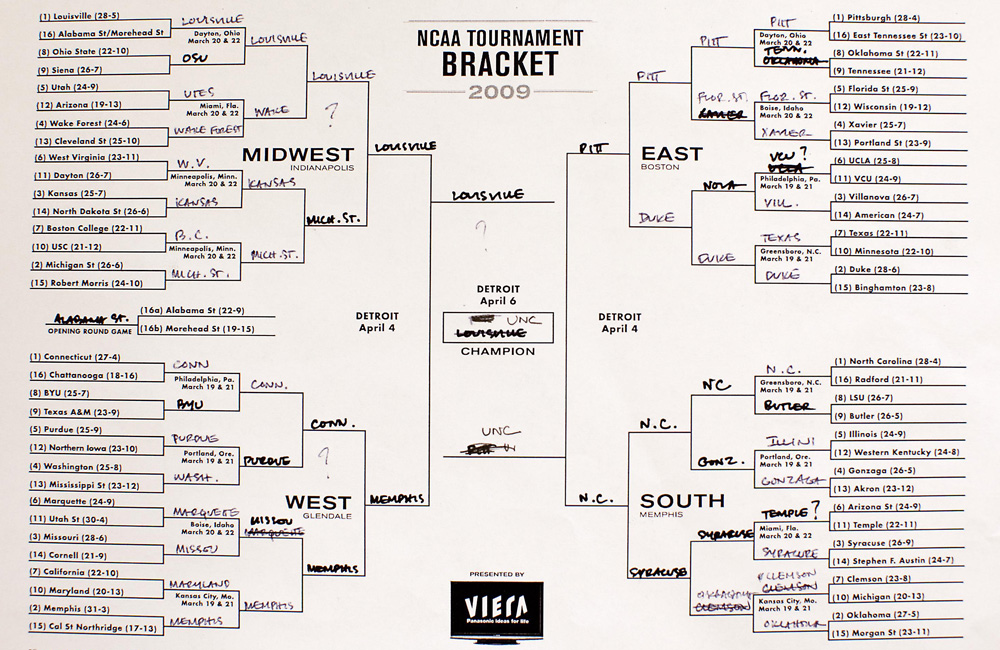
- President Obama's bracket didn't do much better.
- JoeSettler on the latest UN report:
Israel recycles approximately 70% of its waste water. The next closest is Spain at just 12%.- Acharon Acharon Chaviv - a nice and inspiring video, courtesy of Hirhurim, of kids and men (with intro by R' Sacks I believe) singing Oseh Shalom:
EZ Reads: Pesach Cleaning - Jewish Life & Education
- Daled Amos: Today, My Son is a Jew
- Jewboy finds it hard to have sympathy for families who don't have money because they have been and are continuing to support the next generation.
- ProfK on R' Schachter's tuition speech and on commitment to Jewish education.
- Certain issues must be taught better, or we'll have more of these: Domineering husbands (discussed by R' Aviner - important read for all) and Tznius patrols, abuse, violence, and getting personal about Torah (discussed by R' Adlerstein).
- Unfortunately, some people continue to try to solve problems like schools rejecting girls by throwing money at them.
- Adventures in Chinuch discusses the "Uncle Moishy" approach too many people have to Judaism and the education of it, such as a vengeful God.
- He also questions if we teach too much Torah, and how parents need to start taking accountability.
EZ Reads: Pesach Cleaning - Cool Jews
- Jewish CEO of hospital finds an alternative to layoffs, and is praised as a head with a heart. What a huge kiddush Hashem.
- JDA has the "Hebrew Mamita", Vanessa Hidary, performing at Def Poetry Jam. There's some really good stuff in there. {warning: some language in #1}
- Harrisburg girl shows that modesty doesn't have to be boring.
- Yeshiva bochur holds the Mr. Israel bodybuilding title.
- WestBankMama discusses how Jewish brains are solving some major global problems.
- The JPost has a piece on the Z5 - an 18-year old Israeli's creation that reduces car emissions by 40% and cuts down gas consumption.
- Bibi Netanyahu discusses the Palestinian issue - when he was 28 years old. As incredible at public discussion then as he is now.
- Treppenwitz says goodbye for now to a favorite hitchhiker.
EZ Reads: Pesach Cleaning - It's The Economy, Stupid
- To start, it's probably a good idea to know just what a trillion dollars looks like (in hundreds). [Hat tip: Corner Point]
- xkcd says it's also important to be honest about the differences between Millions and Billions.
- On the Jewish side, Nefesh Yehudi sums up what a stimulus is in a funny way...
- ...except it's not so funny when a reporter goes undercover to see how hard it would be to pull a Ponzi scheme on Charedim, and finds it to be incredibly easy.
- Hirhurim says it's not your fault if you're out of a job, and God is not upset at you.
- That won't stop this Indexed, though:
- Speaking of unemployment, the real rate is more like... 19.8%!? Ouch.
- A very interesting piece on usury and how it has changed the approach to debt.
- This honest piece from Howard Marks of Oaktree shows where the models failed, and no matter what changes were made, they simply weren't good enough. It also shows just how unprecedented this drop was.
- The next big shock will be pension underfunding. This is scary.
- Of course, the Obama administration isn't doing much to stop it, just nonsensically limiting bonuses, driving people to foreign banks except where Wall Street gives higher salaries (which cost more than bonuses in the long run, I believe).
- Meanwhile, the government approach is so bad and dishonest that the FHLB chairman actually quit over the FDIC "accounting alchemy", which is just scary. The FHLB is the largest borrower of taxpayer money, at $1.26 trillion.
The year-end balance sheet at the FHLBank of Seattle, for example, showed $5.6 billion of non-government mortgage-backed securities that it says it will hold until maturity. Yet the estimated value of those securities was just $3.6 billion. The bank, which reported a $199.4 million net loss for 2008, said the declines were only temporary. They’ve been anything but fleeting, though. Most of those securities have been worth less than they cost for more than a year.- It's also got huge holes, which allows hedge funds and banks to exploit taxpayer money to protect themselves.
- And most sadly, it may be using companies like AIG to fudge what are normally illegal transactions into legal ones for the purpose of channeling money to banks.
AIG, knowing it would need to ask for much more capital from the Treasury imminently, decided to throw in the towel, and gifted major bank counter-parties with trades which were egregiously profitable to the banks, and even more egregiously money losing to the U.S. taxpayers, who had to dump more and more cash into AIG, without having the U.S. Treasury Secretary Tim Geithner disclose the real extent of this, for lack of a better word, fraudulent scam.

EZ Reads: Pesach Cleaning - Torah, Mussar, & Judaism
- BeyondBT on actualizing the predictable. The post is a fantastic message, learned from Purim, applicable to Pesach and all year round. It's also a perfect response to the widely criticized and mind-boggling article by R' Avi Shafran essentially praising Bernie Madoff while criticizing Captain "Sully" who saved the lives of the people on Flight 1549. As I noted in the comments on Orthonomics' criticism of the piece, I cannot understand what good was even intended to come out of the article, even if R' Shafran had made the points he was attempting to make well. His piece has come off as a true chillul Hashem, which is especially sad as he represents one of the most important constituencies within Judaism.
- On the flip side, Eytan Kobre's excellent piece on Cross-Currents immediately after R' Shafran's explains just how perfect Sully's preparation for that incident was, and what mussar we can learn from that.
- A good piece on BeyondBT on the importance of tradition and ritual, something I think we see especially on Pesach.
- Neil with another beautiful lesson from R' Salanter:
Rabbi Yisrael Salanter use to say: When a child plays with a piece of wood in the bath, and he pretends that it is a ship, if we take the piece of wood away from him he has the same experience as an adult would have if a real ship of his sunk. For the child, the piece of wood is like an adult's ship. When an adult interferes in a child's play, he steals something from the child.- Chana on the idea of surrendering one's mind to God.
- Chief Rabbi Jonathan Sacks on probability and faith.
- A pair of interesting text message psak posts from R' Aviner.
EZ Reads: Pesach Cleaning - Birchas HaChama & Pesach
Please enjoy the eBook on Birchas HaChama that I was fortunate to assist R' Gil Student of Hirhurim in compiling. It is in printable form here. We certainly found it interesting, and hope you will as well. A few other posts and articles I've seen since which were interesting, either on Birchas HaChama or making Pesach:
- Howard Smith (senior astrophysicist at Harvard) in the Jewish Week discusses Birchas HaChama, from its science to its spirituality.
- RafiG's daughter was asked to bring to class a unique chumrah they have for Pesach in their house. Comments are hilarious; personally, the one not to have any other chumras is the best (not the funniest). Better to laugh than to be sad that this is what goes on in schools, right?
- Some fun chumrahs. Gotta boil out that stomach!
- On the more normal side, R' Aviner suggets how to cheerfully clean for Pesach in less than one day.
- Chaim links to a great video.
- NMF#7 discusses shopping for meats in Israel, and finds a great site listing all the cuts of meat and their equivalents in Hebrew. She also has a great story contrasting Israel in '67 to now in terms of the abundance of fruit and vegetables.
EZ Reads: Pesach Cleaning - Sports
- Really great piece in the NYPost on LeBron James by Peter Vescey.
- Jack links to a cool piece that explains how people catch fly balls. (Also cool: Why kids can't hit pitches which are too slow. Throw a little faster.)
If we ask real fielders how they knew where to run to catch a ball, they may not respond with, "Well, I simply adjusted my relative field position to keep the tangent of the vertical optical angle to the ball increasing at a constant rate."- Crazy: Soccer player gets free rent... by living in the fashion store's storefront where everyone on the street can watch his every move. (Via Deadspin, with pic.)
- Bill Simmons wants the NBA teams to start sharing the data they're compiling that analyzes stats in ways geeks only dream of.
- Hollinger notes that LeBron may be putting together the most efficient season in NBA history.
- Brilliant heads-up play by an Israeli soccer ball boy gets his favorite team a goal. This got international play.
- Interesting WSJ piece discussing how CBS switches between NCAA games during the tournament. If you've been watching (or listening on Westwood One on the radio, which was equally as impressive), they've done a fantastic job of going from game to game at just the right times.
- Wonderlic scores for the NFL. This is the 15-minute test NFL players take, and reporters mock them for scoring only about a 21 on average on (out of 50 questions, which you need to answer as many as you can as quickly as you can correctly). A couple of years ago the players made the reporters take it as well; they scored an average of 23, lower than your average offensive lineman, if I recall correctly.
Sunday, April 05, 2009
Dovid Chaim
UPDATE: Unfortunately, David was niftar the next day after this was posted. Baruch Dayan Emes. Please check the site for more information regarding learning in his honor and more.
Serach came home talking about this boy, and YD and others have mentioned it as well. Please daven for a Refuah Shleimah for Dovid Chaim Yoseif ben Sima Perel. David Rottenstreich is a 20 year old from Queens who is currently in YU. From the family:
Serach came home talking about this boy, and YD and others have mentioned it as well. Please daven for a Refuah Shleimah for Dovid Chaim Yoseif ben Sima Perel. David Rottenstreich is a 20 year old from Queens who is currently in YU. From the family:
David was diagnosed with pneumonia in both lungs on Thursday night, April 2nd. Friday morning he woke up with a very high fever and was brought to New York Hospital of Queens. There, he was diagnosed with staphylococcus pneumonia, a very serious infection that attacked his lungs. The doctors decided that it would be better if he would be in the city in case of an emergency. He was transfered to Cornell in the city moments before Shabbos. At Cornell, he suffered severe lung damage which caused respiratory failure. Due to the respiratory failure, David's heart began to shut down. As a last resort, David was taken to Columbia Presbyterian Hospital, to the ICU, where they have a life support machine that bypasses the lungs and heart. The doctors are hoping that they will be able to sustain him on the life support machine, so they can continue to fight the infection. If they are able to fight the infection, they hope to be able to slowly bring him off the machine and to a full recovery. Right now, some of his blood levels are slightly better, B"H, and we are hoping that slowly we will see baby steps to a refuah shelima.In addition, please also have in mind an old Rebbe of mine's son:
I just wanted to let you know that Yaakov Yitzchak ben Rut Nechama (Rabbi Buckler's son) is now Refael Yaakov Yitzchak ben Rut Nechama. If you could update your readers, I would really appreciate it. He just had a CT scan which unfortunately showed that the chemotherapy is not helping.And also please have in mind our very close friend Aliza, who I wrote about once before: Aliza Rochel bas Liba Yenta.
It'll Be A Fun 3-Day Yom Tov
The last time we went to Cleveland for Pesach, after 80-degree sunny skies on the first day of Yom Tov, we were hit with 28-degree temperatures and 8 inches of snow starting on the second day. That's a 52-degree drop in about 24 hours.
This time, we probably won't see as much of a fluctuation: It'll just be dreary.
 Sigh.
Sigh.
I'm guessing we may not be making Birchas HaChama...
This time, we probably won't see as much of a fluctuation: It'll just be dreary.
Sigh.I'm guessing we may not be making Birchas HaChama...
Birchas Ha'Ilanos Map (Blessing on the Trees)
Lost in the hubbub over the once-in-28-years Birchas HaChama is the once-a-year opportunity to make the Birchas Ha'Ilanos (which is supposed to be done in Nisan, if I'm not mistaken). Via Josh L, who sent out a nice listing of all the places where one can do so in many Orthodox Jewish communities, comes a map created by a man named Nesanel, who upon seeing that listing, said:
After I got the list of fruit trees from you, I thought it was a shame thatIt's great. Check it out.
it wasn't in database format with an interactive map.
So, I created: http://fruittrees.citykol.com/
Friday, April 03, 2009
EZ Reads, 4/3
A few nice reads to head into Shabbos with: {excerpts on expand}
Have a wonderful Shabbos!
- Excellent post by JACP on freedom and letting go of resentment (with many other applications)
You know, each of us have people in our lives who have hurt us and caused us some miserable times. They're hard to forgive and let go of. I know. I've had plenty of hurts myself.
But twenty years, or even twenty minutes after the event, when you're still smarting at what this person may have done to you, do you think they're thinking about you too? Do you think that all the years you wasted hating them and wishing things would have worked out differently are being hated and wished away by that other person as well?
I doubt it.- Adventures in Chinuch with a good vort (as usual) on Shabbos HaGadol
It is incumbent upon us to understand that not everyone thinks the same way, and that some are affected more by uncertainty, and some less. If none of us can be completely sure, how can we expect that of others?- ParshaBlog questions whether the MO community should say Birchas HaChama
This is a problem for Modern Orthodox people for three reasons:
Do we believe in a Young Earth or an Old Earth? This is all predicated on it being the time the earth was created, thus on it being a Tuesday going into Wednesday, as Rashi explains Abaye's statement. But what if we do not understand Bereishit to be literal in this manner?- Interesting piece in the WSJ on Birchas HaChama
- I could have told Freakonomics this one (though of course there's a balance):
The increase is startling; workers who spend as much as 20 percent of their office time leisure browsing actually get more work done than workers who don’t.- Via Freakonomics, Penn Jillette on CNN discussing counter-intuitiveness - and its limits.
Handling fire seems like a superpower. There are whole seminars and self-help jive centered on fire-walking, which is hustled as "mind over matter," or "empowerment" but is really just counterintuitive physics. As long as the fire walk is set up right and you keep moving, you can even hope and pray to be burned, while yelling counter-self-help slogans such as "I do not have any power to do this" and "universe, please burn my little piggies," and you'll be fine.
The Dissipating Wealth
In the comments on yesterday's post, an anonymous commenter made an important point that brought to mind a clearer explanation of the problem the Jewish community now faces.
The great majority of the Jewish community who work are in white-collar, service industries. Lawyers, accountants, finance and real estate businessmen; even teachers, therapists, psychologists, and doctors. Within the community as a whole, almost no goods are produced other than those meant to be sold within the community itself. There are almost no goods produced within the Orthodox Jewish community that are designed to be sold to the mass public.
What this means for us as a community is that when we go to a store and buy a product, whether food or a toy or some home accessory, we are either sending money into a circle within the community [such as baker -> grocer -> shipper -> factory -> factory owner -> baker], with any profits and earnings in between siphoning off a portion to government, or we are just sending the money straight out of the community to companies that are not part of the Orthodox Jewish community.*
The only way for us to produce even those goods that remain within the community and the only way for us to import the goods that are from outside of the community is by bringing wealth into the community. There are two ways to bring wealth into a community:
What is especially difficult about this is that at present, we don't have a direct solution to this issue. Our professionals and service providers will have to patiently wait out the downturn for the most part. There are only two real offsets that can be reasonably pursued - cutting costs, which we should certainly be doing regardless, and creatively coming up with ways to produce more: And that production has to be directed not just at our own community but at the broader world.**
Finally, and most importantly, we don't have much time.
* 1) I am not at all advocating the idea of "we must buy only from frum stores". If other places can produce the same goods for less, we should certainly not pay extra to get those goods.
2) Particularly because it costs us more to produce those same goods, we end up with an inflated internal economy. Jewish stores charge higher prices to cover their costs, and since our wealth is coming from outside the community while we spend inside, we don't have an accurate sense of what these things should cost, so we're not even fully aware of the built-in inflated cost. Once the wealth is gone, we're still not only missing the wealth, but paying inflated prices on what we need, too.
** This is probably the main reason smaller Jewish communities tend to be far more stable economically than larger ones. In addition to the reduced inflationary spending within the community, any businesses are directed far more at the greater public than at the Orthodox Jewish segment, meaning that they are bringing wealth from outside sources into the community.
The great majority of the Jewish community who work are in white-collar, service industries. Lawyers, accountants, finance and real estate businessmen; even teachers, therapists, psychologists, and doctors. Within the community as a whole, almost no goods are produced other than those meant to be sold within the community itself. There are almost no goods produced within the Orthodox Jewish community that are designed to be sold to the mass public.
What this means for us as a community is that when we go to a store and buy a product, whether food or a toy or some home accessory, we are either sending money into a circle within the community [such as baker -> grocer -> shipper -> factory -> factory owner -> baker], with any profits and earnings in between siphoning off a portion to government, or we are just sending the money straight out of the community to companies that are not part of the Orthodox Jewish community.*
The only way for us to produce even those goods that remain within the community and the only way for us to import the goods that are from outside of the community is by bringing wealth into the community. There are two ways to bring wealth into a community:
- 1) Export goods outside of the community in exchange for money or goods; or
- 2) Be a service provider of some sort, whether financial services, medicine, etc., to those outside of the community.
What is especially difficult about this is that at present, we don't have a direct solution to this issue. Our professionals and service providers will have to patiently wait out the downturn for the most part. There are only two real offsets that can be reasonably pursued - cutting costs, which we should certainly be doing regardless, and creatively coming up with ways to produce more: And that production has to be directed not just at our own community but at the broader world.**
Finally, and most importantly, we don't have much time.
* 1) I am not at all advocating the idea of "we must buy only from frum stores". If other places can produce the same goods for less, we should certainly not pay extra to get those goods.
2) Particularly because it costs us more to produce those same goods, we end up with an inflated internal economy. Jewish stores charge higher prices to cover their costs, and since our wealth is coming from outside the community while we spend inside, we don't have an accurate sense of what these things should cost, so we're not even fully aware of the built-in inflated cost. Once the wealth is gone, we're still not only missing the wealth, but paying inflated prices on what we need, too.
** This is probably the main reason smaller Jewish communities tend to be far more stable economically than larger ones. In addition to the reduced inflationary spending within the community, any businesses are directed far more at the greater public than at the Orthodox Jewish segment, meaning that they are bringing wealth from outside sources into the community.
Subscribe to:
Posts (Atom)